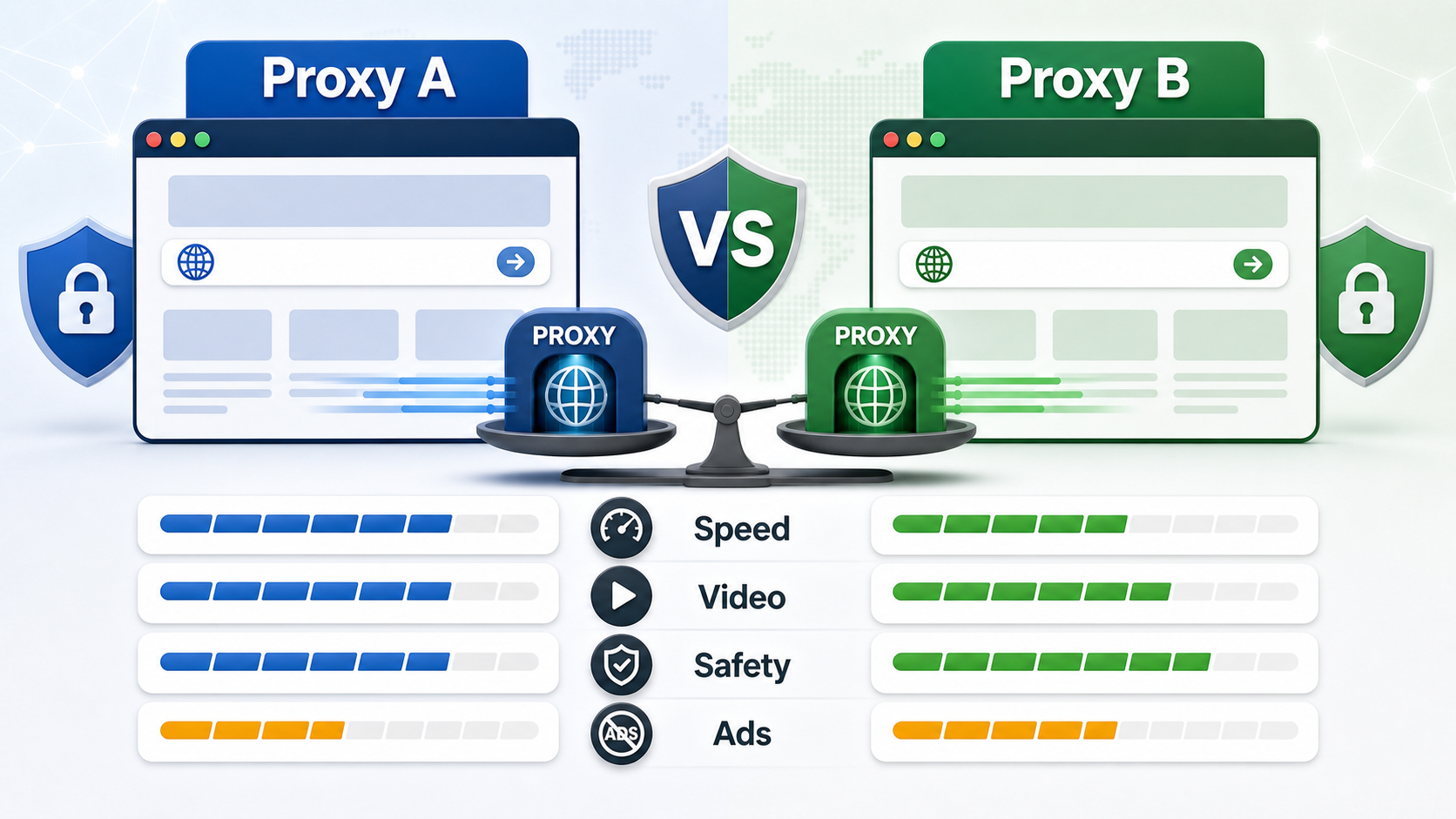
BlockAway vs CroxyProxy: Which Free Web Proxy Is Better? helps readers match BlockAway-related search intent to the right safety, troubleshooting, comparison, or proxy-infrastructure decision.
BlockAway and CroxyProxy satisfy similar free-web-proxy intent: users want a browser-based way to open blocked pages, watch videos, or access social sites without installing a VPN.
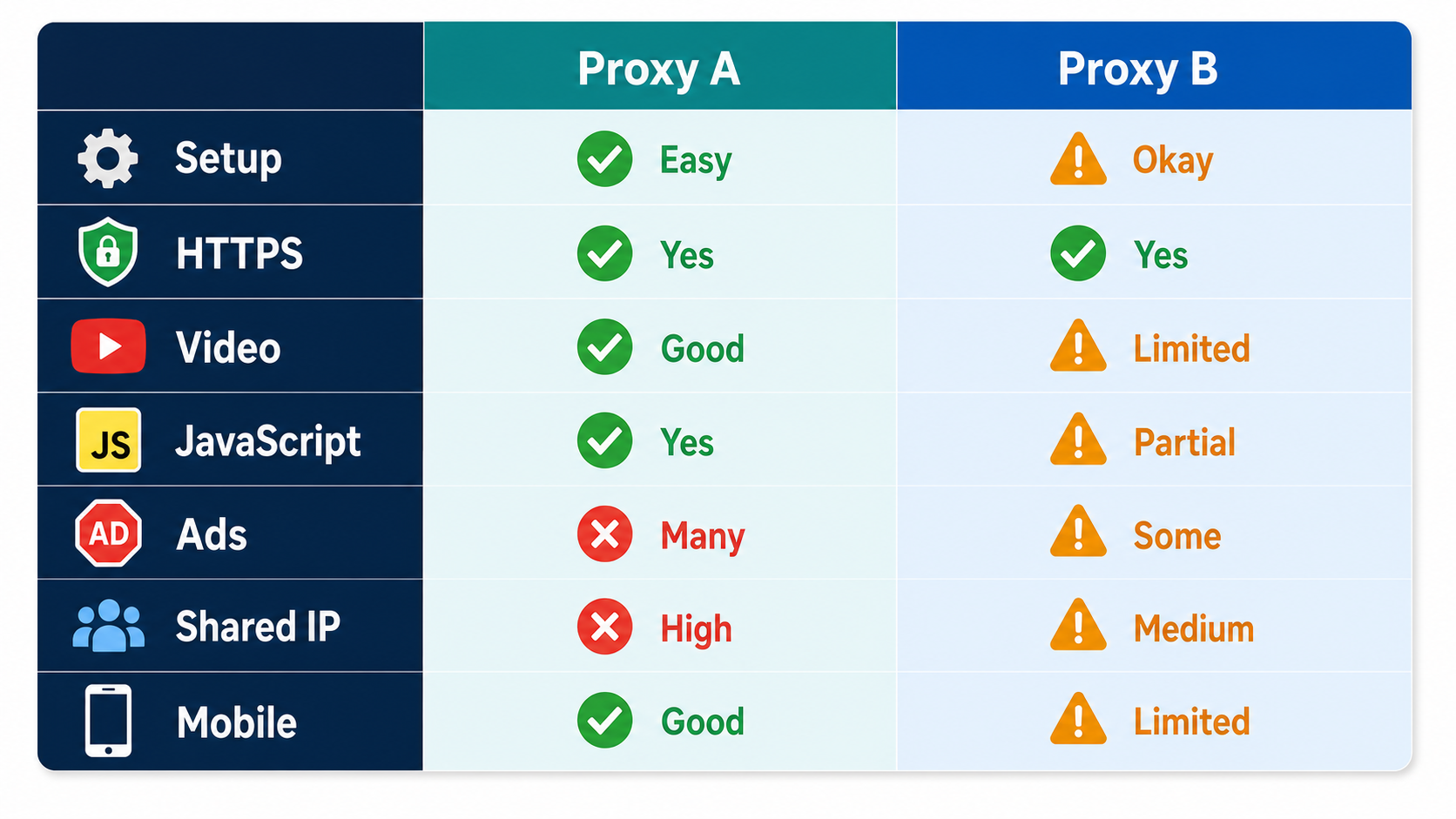
Quick comparison
| Factor | What matters | Practical take |
|---|---|---|
| Setup | No app, browser-only access | Both are low-friction |
| Video | Media routing and bandwidth | Expect inconsistency on free proxy paths |
| Safety | Shared IPs, logs, trust point | Do not use either for sensitive accounts |
| JavaScript | Code rewriting and asset routing | Modern apps may break |
| Upgrade path | Need repeatability or account stability | Use static residential proxy planning or rotating residential proxies |
Why users search BlockAway proxy Croxy
The query usually signals interface and backend curiosity. Users see similar proxy behavior, CDN routes, or page rewriting and want to know whether the tools are connected. Instead of treating that as a brand claim, evaluate the workflow: speed, support for video, broken layouts, ads, and account risk. For broader unblocker intent, compare the website unblocker comparison.
Speed and video playback
Free proxy speed depends on shared servers and route congestion. Video adds more stress because media streams are bandwidth-heavy and more likely to trigger restrictions.
Safety and shared IP risk
The MDN proxy servers and tunneling guide gives the neutral HTTP proxy foundation. The practical safety issue is that both free tools route traffic through shared infrastructure. For automated or account-based workflows, OWASP's OWASP automated threats guidance is a reminder that sites actively detect abnormal automation patterns.
Best upgrade path
If the task is casual public access, either style of web proxy may be enough. If you are doing data collection, QA, or browser automation, move to the Playwright stealth workflow, Google Maps lead scraper workflow, or LycheeIP proxy infrastructure.
Where LycheeIP fits
LycheeIP is not a replacement for casual web proxies in every low-risk case. It is for teams that need cleaner IP choices, session control, geographic targeting, and workflow reliability. Start with LycheeIP proxy infrastructure, review the residential proxy guide, compare datacenter proxies, and use the AI-powered browser automation hub when browser behavior is part of the workflow.
Related BlockAway guides
Use these supporting guides to move from one broad BlockAway query into the exact intent you need.
- BlockAway proxy review
- BlockAway alternatives
- Is BlockAway safe?
- BlockAway not working
- Free web proxy vs VPN vs rotating proxy
Explore LycheeIP Proxy Infrastructure
Frequently Asked Questions
Is BlockAway the same as CroxyProxy?
They serve similar free web proxy intent, but this article avoids making ownership claims and compares the workflow instead.
Which is faster?
Speed varies by server load, target site, media requests, and shared IP reputation.
Which is safer?
Neither should be used for sensitive logins or private data.
Why do users search BlockAway proxy Croxy?
They may notice similar behavior, interface patterns, or proxy routing and want to compare the tools.
When should I use LycheeIP instead?
Use LycheeIP when you need stable sessions, request distribution, location control, or automation reliability.