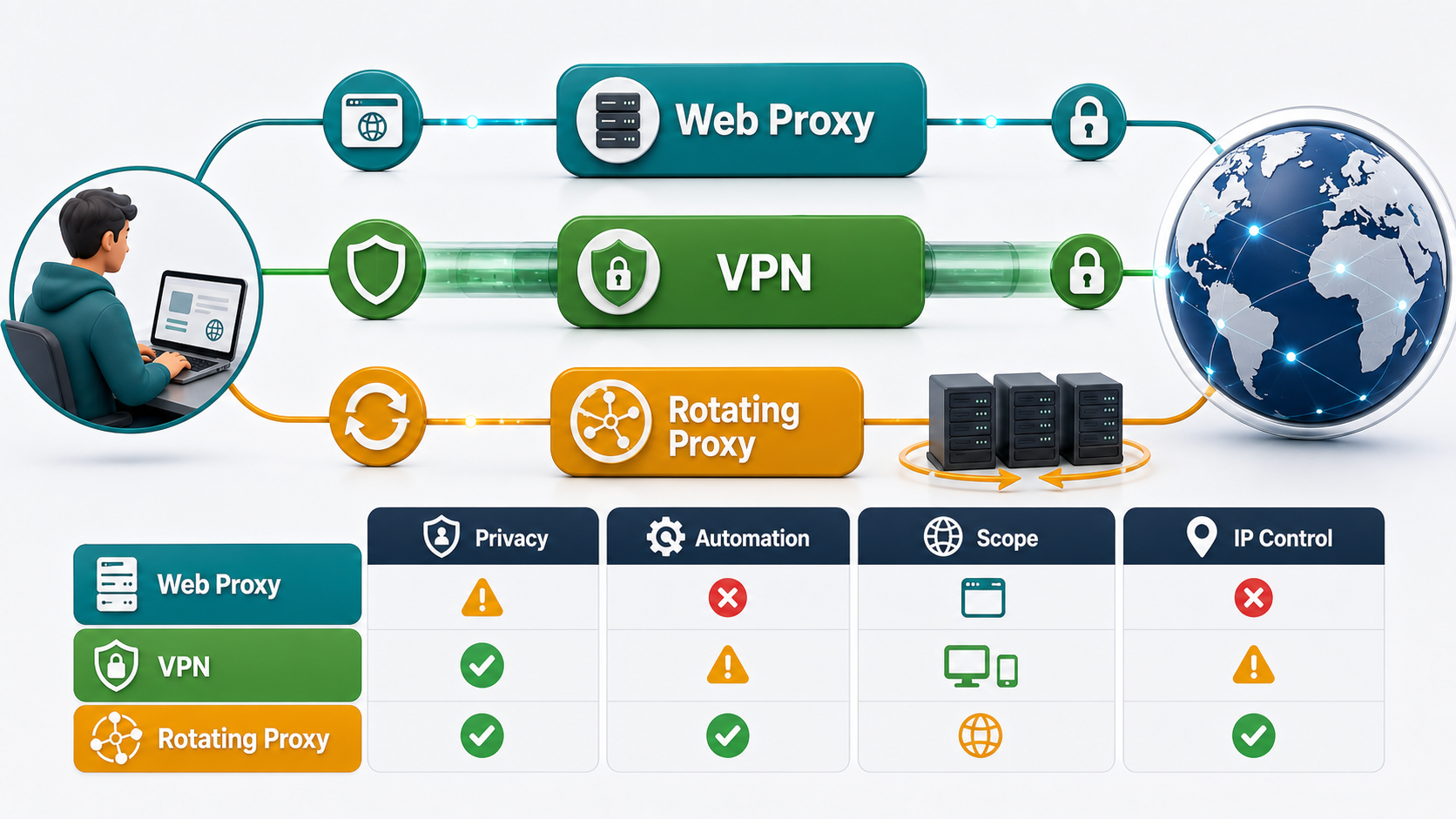
Free Web Proxy vs VPN vs Rotating Proxy: Which Should You Use? helps readers match BlockAway-related search intent to the right safety, troubleshooting, comparison, or proxy-infrastructure decision.
A free web proxy, a VPN, and a rotating proxy all change how traffic reaches a website, but they solve different problems. Choosing the wrong one creates false expectations about privacy, speed, automation, and IP control.
Quick answer
| Tool | Best for | Weakness |
|---|---|---|
| Free web proxy | Casual blocked public pages | Browser-only and weak trust boundary |
| VPN | Personal privacy and whole-device traffic | Limited automation and IP selection |
| Rotating proxy | SEO, scraping, testing, and distributed requests | Needs setup and responsible rate control |
| Static proxy | Account workflows and geo QA | Less diversity than rotation |
| Datacenter proxy | Fast lower-risk checks | Easier to detect on sensitive targets |
If you arrived from BlockAway search intent, start with the BlockAway proxy review and the website unblocker comparison first, then use this page to choose the right upgrade path.
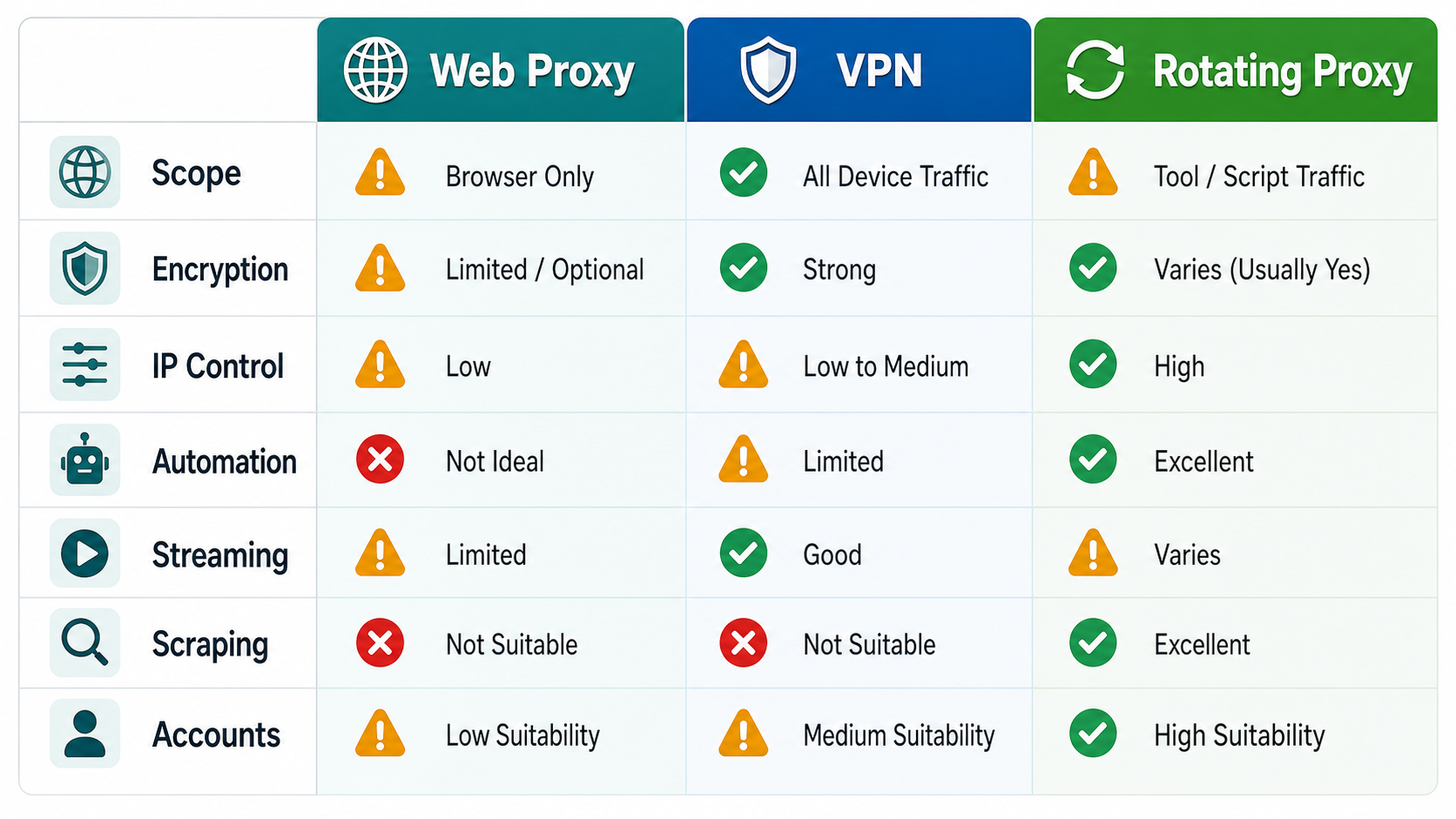
Free web proxy
A free web proxy runs inside a browser page. It is useful for simple access, but it usually uses shared infrastructure and is not designed for sensitive logins or repeatable production work. The HTTP Semantics standard is the standards reference for HTTP behavior behind these tradeoffs.
VPN
A VPN is usually better for personal privacy because it can route traffic beyond one browser tab. It is still not a magic anti-detection tool for scraping, account automation, or localized QA.
Rotating proxy
Use rotating residential proxies when you need IP diversity, request distribution, localized collection, SEO monitoring, or workflows that should not rely on one shared free proxy route.
Static proxy and datacenter proxy
Use static residential proxy planning when account continuity matters, and datacenter proxies when speed and cost matter more than residential realism. For implementation details, the residential proxy guide and SOCKS5 and HTTPS proxy setup guide are better next reads than another free proxy list.
How to choose responsibly
Match the tool to the workload, respect site terms, keep request volume reasonable, and use monitoring. For SEO pages, track changes in impressions and CTR with the Google Search Console performance report after internal linking is live.
Where LycheeIP fits
LycheeIP is not a replacement for casual web proxies in every low-risk case. It is for teams that need cleaner IP choices, session control, geographic targeting, and workflow reliability. Start with LycheeIP proxy infrastructure, review the residential proxy guide, compare datacenter proxies, and use the AI-powered browser automation hub when browser behavior is part of the workflow.
Related BlockAway guides
Use these supporting guides to move from one broad BlockAway query into the exact intent you need.
- BlockAway proxy review
- BlockAway alternatives
- Is BlockAway safe?
- BlockAway vs CroxyProxy
- BlockAway not working
Explore LycheeIP Proxy Infrastructure
Frequently Asked Questions
Is a free web proxy the same as a VPN?
No. A free web proxy usually works in one browser page, while a VPN can route traffic more broadly.
Is a rotating proxy better than a VPN?
For scraping, SEO, automation, and geo QA, often yes. For personal privacy, a VPN is usually simpler.
Can I use a free web proxy for accounts?
Avoid it. Shared IPs and weak trust boundaries can trigger account risk.
When should I use datacenter proxies?
Use them for fast lower-risk checks where targets tolerate hosting IPs.
Which tool should SEO teams use?
SEO teams usually need rotating or static proxy infrastructure, not a free web proxy.