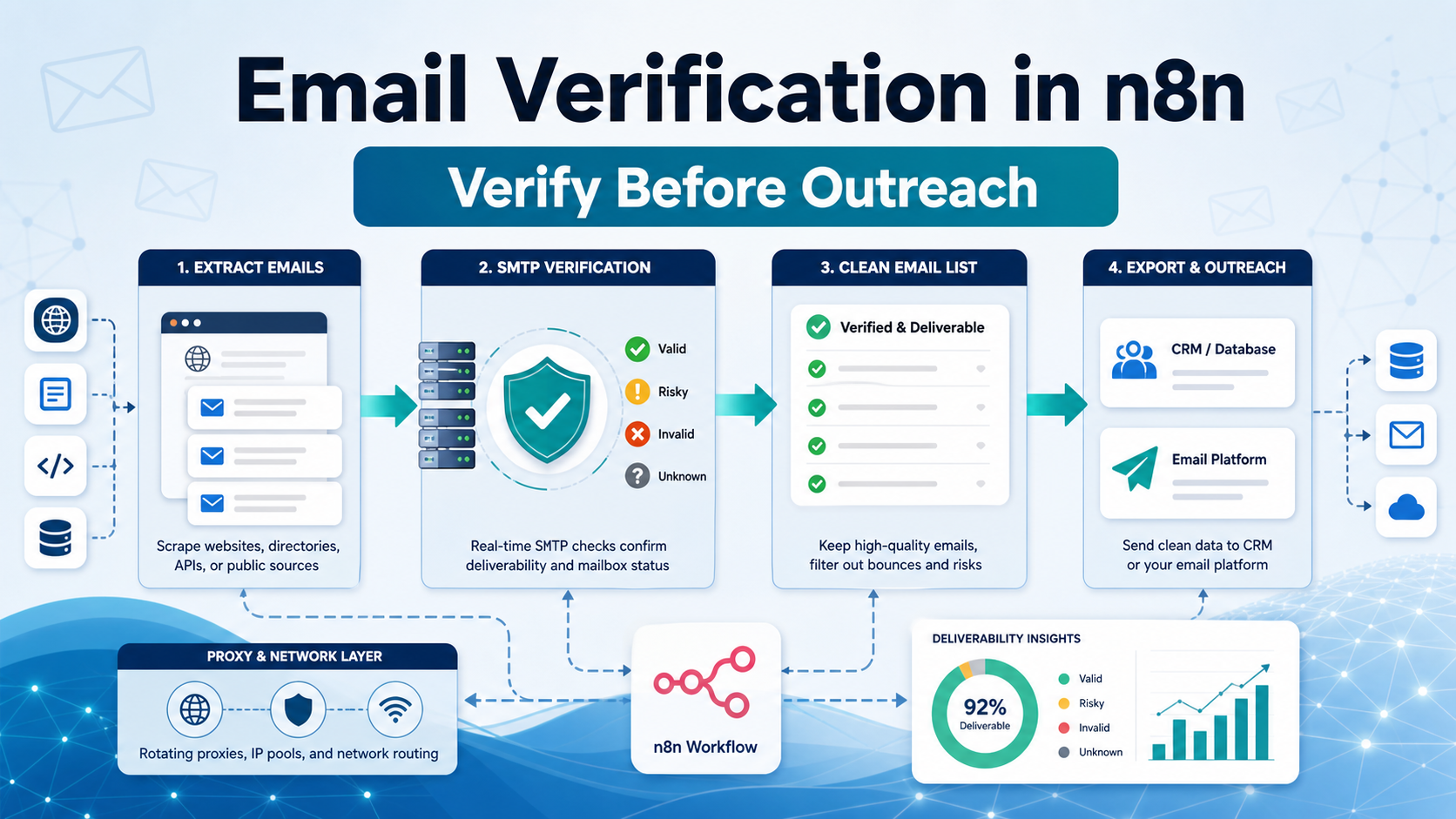
Never send to a bad email again—verify before you scrape. Scraped email lists often carry bounce rates between 20% and 40%, which can damage your sender reputation, trigger spam filters, and reduce the effectiveness of your entire outreach operation. For cold email marketers and lead generation specialists, the quality of your contact data directly impacts deliverability scores, open rates, and ultimately conversion. The solution is straightforward: integrate SMTP verification directly into your n8n scraping workflows before those contacts ever reach your CRM or email platform.
This article was prepared for practitioners who care about routing quality, operational reliability, and the real-world tradeoffs behind IP privacy, cloud security, email verification, and automation workflows.
For official technical background, see IANA number resources, ARIN IPv4 resources, RFC 791 Internet Protocol, MDN X-Forwarded-For reference.
Integrating Live SMTP Verification Into n8n Scraping Workflows
When you scrape contact information from public sources, LinkedIn profiles, company websites, or directory listings, you collect email addresses that may be outdated, mistyped, or simply fake. Many websites display contact information that has not been updated in months or years. Others use placeholder addresses or honeypot emails designed to catch scraping bots.
Email verification through SMTP validation checks whether an email address is deliverable without actually sending a message. The process queries the recipient mail server to confirm that the mailbox exists and can receive messages. This real-time verification happens in milliseconds and can be automated directly within n8n workflows.
Why SMTP Verification Matters for Scraped Data
Scraped email addresses face specific quality challenges:
- Format errors: Copy-paste mistakes, OCR errors from PDFs, or truncated strings
- Disposable addresses: Temporary emails used for form submissions
- Role addresses: Generic addresses like info@domain.com that often have poor engagement
- Inactive mailboxes: Employees who left companies or addresses that were never activated
- Catch-all domains: Servers that accept all addresses but may not deliver messages
Each invalid email in your outreach list increases your bounce rate. Email service providers track bounce rates closely. Consistent bounces above 5% can result in throttling, account warnings, or permanent blacklisting. For cold email campaigns, maintaining a bounce rate below 2% is essential for long-term deliverability.
Building Verification Into n8n Workflows
n8n provides the flexibility to add verification steps immediately after data extraction. The workflow structure looks like this:
1. Scrape source data using HTTP Request nodes, Puppeteer, or API calls
2. Extract email addresses from scraped HTML or JSON responses
3. Validate format using regex or basic validation nodes
4. Query SMTP server through verification API or custom function
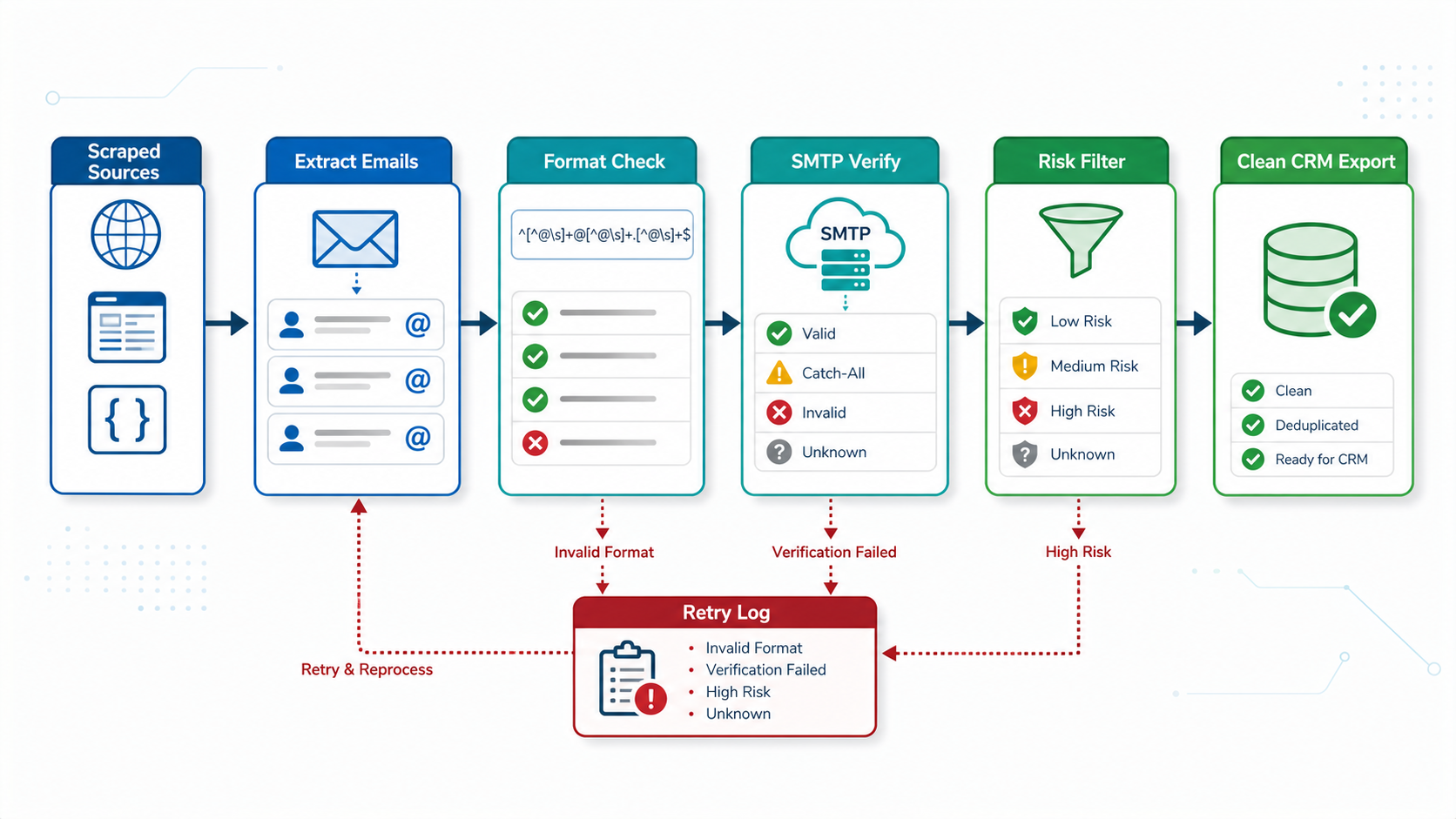
5. Filter results based on verification status
6. Export clean data to CRM, CSV, or email platform
The SMTP verification step happens between extraction and export. Most verification services provide REST APIs that integrate directly with n8n HTTP Request nodes. You send the email address as a parameter and receive a response indicating whether the address is valid, invalid, risky, or unknown.
Choosing Verification Services for n8n
Several email verification services offer API access suitable for n8n workflows:
Explore LycheeIP Proxy Infrastructure
- ZeroBounce: Provides detailed validation including spam trap detection and abuse email flagging
- NeverBounce: Real-time verification with bulk processing options
- EmailListVerify: Cost-effective validation with catch-all detection
- Hunter.io: Email finder and verification combined
- Abstract API: Simple REST endpoints for basic validation
Each service returns different data points. At minimum, you need a deliverable/undeliverable status. More advanced services provide confidence scores, mailbox status, domain health, and suggestions for corrected addresses.
When scraping at scale, verification costs become a budget consideration. Most services charge per verification, with rates between $0.001 and $0.01 per email depending on volume. For workflows processing thousands of emails daily, these costs add up but remain significantly cheaper than the reputational damage from high bounce rates.
Proxy Infrastructure and Verification Workflows
When running large-scale scraping operations that feed into verification workflows, proxy rotation becomes essential. Target websites often implement rate limits or blocks against IP addresses making repeated requests. Verification APIs themselves may throttle requests from single IP addresses.
Using residential or datacenter proxies allows your n8n workflows to distribute requests across multiple IP addresses, avoiding detection and maintaining consistent scraping performance. For email verification specifically, datacenter proxies typically provide sufficient anonymity and speed since verification APIs are commercial services designed to handle high request volumes.
When scraping public data sources for contact information, residential proxies offer better success rates against anti-bot measures. E-commerce sites, directories, and social platforms detect and block datacenter IPs more aggressively. Rotating residential proxies help maintain access while respecting rate limits and terms of service.
LycheeIP provides proxy infrastructure suitable for scraping workflows that require consistent access to public data sources. Whether using residential proxies for complex scraping tasks or datacenter proxies for API-heavy verification workflows, maintaining reliable IP rotation helps prevent interruptions in automated lead generation pipelines.
Filtering Invalid Emails Automatically Before Export
Once verification runs within your n8n workflow, the next step is implementing smart filtering logic that removes or flags problematic addresses before they reach your outreach tools.
Email Workflow Video Walkthrough
Creating Filter Rules
Not all verification results require the same action. A basic three-tier filtering system works for most workflows:
Valid addresses: Email addresses that pass all verification checks and show active mailboxes. These proceed directly to your CRM or email platform.
Risky addresses: Catch-all domains, role addresses, or mailboxes with uncertain status. These may be quarantined for manual review or tagged with lower priority in your outreach sequence.
Invalid addresses: Hard bounces, syntax errors, or non-existent domains. These should be removed entirely from your contact list.
In n8n, you implement this logic using Switch or IF nodes that route emails based on verification response fields. For example:
```
IF verification_status = "valid" → Add to Google Sheets
IF verification_status = "risky" → Add to Review Queue
IF verification_status = "invalid" → Log and discard
```
This conditional routing ensures only quality contacts reach your outreach platform while maintaining records of filtered addresses for analysis.
Handling Edge Cases
Several verification scenarios require special handling:
Catch-all domains: These servers accept all email addresses but may not deliver messages to non-existent mailboxes. Some senders exclude catch-all addresses entirely. Others send to them but track performance separately.
Temporary failures: SMTP servers occasionally return temporary errors due to maintenance or load. Implementing retry logic for temporary failures improves accuracy.
Disposable email services: Addresses from services like Mailinator or 10MinuteMail should be filtered out. Most verification APIs flag these automatically.
Free email providers: Gmail, Yahoo, and Outlook addresses may be valid but carry different engagement characteristics than corporate emails. Some lead generation workflows segment free providers separately.
Enrichment During Verification
Beyond simple valid/invalid checks, email verification can enrich your contact data:
- Domain analysis: Company size, industry, and domain age
- Mailbox type: Personal vs. role-based addresses
- Risk scores: Likelihood of bouncing or marking as spam
- Suggested corrections: Common typos like gmial.com corrected to gmail.com
Enriched data helps prioritize outreach. Corporate addresses from established domains typically convert better than free email providers or newly registered domains. n8n workflows can route contacts differently based on these enrichment signals.
Maintaining Verification Logs
Tracking verification results over time provides valuable insights:
- Which scraping sources produce the highest quality emails
- How often specific domains fail verification
- Whether verification accuracy matches actual bounce rates
- Cost per verified email by source
Storing verification metadata in Airtable, Google Sheets, or a database allows you to analyze lead quality trends and optimize scraping targets. If a particular directory consistently yields 60% invalid emails, you can deprioritize or exclude it from future scraping runs.
Maintaining Sender Reputation With Clean Lead Lists
Email deliverability depends on sender reputation, which major email providers calculate based on bounce rates, spam complaints, engagement metrics, and authentication protocols. Maintaining a clean lead list through verification directly protects your sender reputation.
How Bounces Damage Reputation
When you send to an invalid address, the recipient mail server returns a bounce notification. Hard bounces indicate permanent delivery failures like non-existent mailboxes. Soft bounces suggest temporary issues like full inboxes.
Email service providers track both bounce types. A single campaign with 10% hard bounces can trigger immediate throttling. Repeated poor performance results in:
- Placement in spam folders instead of inboxes
- Complete blocking by major providers
- Blacklisting by spam monitoring services
- Suspension or termination of your sending account
Recovering from reputation damage takes weeks or months. Prevention through verification is far more efficient than remediation.
Setting Quality Thresholds
Not every scraped email needs verification. Balancing cost and quality depends on your use case:
High-volume, low-value campaigns: Verify all addresses to protect sender reputation across large contact lists.
Targeted outreach: For smaller, high-value prospect lists, verification plus manual review ensures maximum quality.
Ongoing scraping: Implement verification as a standard step in all lead generation workflows to maintain consistent quality.
Some teams set acceptance thresholds based on verification confidence scores. For example, only emails with 95%+ confidence proceed to outreach, while 80-95% confidence addresses undergo manual verification.
Compliance Considerations
Verifying scraped emails helps with compliance, but verification alone does not make unsolicited outreach legal or appropriate. Cold email regulations vary by jurisdiction:
- CAN-SPAM (United States): Requires accurate header information, clear opt-out mechanisms, and honoring unsubscribe requests
- GDPR (European Union): Requires legitimate interest or consent for processing personal data
- CASL (Canada): Requires express or implied consent before sending commercial messages
Email verification confirms deliverability but does not establish consent. When scraping public contact information, ensure your outreach strategy includes proper opt-out mechanisms and respects applicable regulations.
Additionally, respect robots.txt files and website terms of service when scraping. Many websites explicitly prohibit automated data collection. For legitimate public data workflows like market research, competitive analysis, or directory aggregation, use scraping responsibly with appropriate rate limiting and proxy rotation.
Monitoring Ongoing Performance
Even with verification, monitor actual bounce rates and engagement metrics:
- Track bounce rates for each campaign and compare against verification predictions
- Measure open and click rates to assess overall list quality
- Monitor spam complaint rates which can indicate poor targeting regardless of deliverability
- Review unsubscribe rates as high unsubscribe rates may signal list quality issues
If verified emails still produce high bounce rates, your verification service may not be accurate, or you may need stricter filtering rules. Conversely, if risky addresses perform well, you might relax filters slightly to capture more leads.
LycheeIP and Email Verification Workflows
Email verification workflows often depend on reliable scraping infrastructure. Whether you are collecting contacts from company websites, professional directories, or e-commerce platforms, consistent access to target sites requires proxy infrastructure that handles rate limits, geo-restrictions, and anti-bot measures.
LycheeIP provides proxy solutions for teams building automated lead generation and public data collection workflows. residential proxies help maintain access to sites with strict bot detection, while datacenter proxies offer cost-effective solutions for API-heavy verification processes.
When building n8n workflows that combine scraping and verification, consider:
- Rotating residential proxies for scraping contact pages and directory listings
- datacenter proxies for API requests to verification services
- Geographic targeting when scraping region-specific business directories
- Session persistence for sites requiring login or multi-step navigation
proxy infrastructure integrates directly into n8n through HTTP Request node configuration or dedicated proxy nodes, allowing you to route scraping traffic through different IP addresses while maintaining verification requests from your primary infrastructure.
Common Mistakes and Considerations
Several pitfalls can undermine email verification workflows:
Over-Reliance on Verification
Verification confirms deliverability but not engagement. A valid email address may belong to someone with no interest in your offer. Verification should complement, not replace, proper list targeting and segmentation.
Skipping Format Validation
SMTP verification costs money. Running basic format checks first (valid syntax, no obvious typos, proper domain structure) filters out clearly invalid addresses before spending on API calls.
Ignoring Verification Latency
SMTP checks can take several seconds per email. For workflows processing thousands of addresses, verification becomes a bottleneck. Batch processing, parallel requests, and asynchronous nodes help maintain throughput.
Not Updating Verified Lists
Email validity degrades over time. People change jobs, companies close, and mailboxes fill up. Re-verifying contacts every 3-6 months maintains list quality, especially for ongoing nurture campaigns.
Verification Without Rate Limiting
Hammering verification APIs with unlimited concurrent requests may trigger rate limits or service disruptions. Implement request throttling in n8n to stay within API quotas and avoid temporary bans.
Mixing Verification Methods
Different verification services use different methodologies and return different accuracy levels. Mixing services within a single workflow can produce inconsistent results. Standardize on one service or implement clear fallback logic.
Storing Unverified Data
Once you identify invalid emails, ensure they do not reenter your workflow through data syncs or imports. Tag verified status in your CRM and exclude unverified contacts from future campaigns.
Conclusion
Integrating SMTP verification into n8n scraping workflows transforms unreliable scraped data into clean, deliverable contact lists. By verifying emails immediately after extraction and before export, you protect sender reputation, reduce bounce rates, and improve outreach effectiveness. The workflow structure is straightforward: scrape, verify, filter, and export only validated contacts.
For cold email marketers and lead generation specialists, verification is not optional. The reputational cost of high bounce rates far exceeds the per-email cost of verification. Building verification into automated workflows ensures consistent quality without manual intervention, allowing you to scale lead generation while maintaining deliverability standards.
Combining smart scraping infrastructure, reliable proxy rotation, and automated verification creates a sustainable lead generation system that produces quality contacts at scale.
Frequently Asked Questions
What is SMTP email verification?
SMTP verification checks whether an email address can receive messages by querying the recipient's mail server without sending an actual email. The process verifies domain validity, mailbox existence, and server responsiveness in real time.
Why do scraped email lists have high bounce rates?
Scraped emails often include outdated addresses, formatting errors, placeholder emails, and inactive mailboxes. Public sources rarely update contact information regularly, leading to data quality issues that cause delivery failures.
How much does email verification cost?
Most verification services charge between $0.001 and $0.01 per email depending on volume. Bulk pricing typically reduces costs, with enterprise plans offering unlimited verification for monthly fees.
Can I verify emails without an API service?
Yes, you can build custom SMTP verification using n8n function nodes and SMTP libraries, but commercial services provide additional features like catch-all detection, spam trap identification, and disposable email filtering that improve accuracy.
What is a catch-all email domain?
A catch-all domain accepts all incoming emails regardless of whether the specific mailbox exists. These domains pass basic SMTP checks but may not actually deliver messages to non-existent addresses, making them risky for outreach.
Should I verify emails before or after scraping?
Verify after scraping but before adding contacts to your CRM or email platform. This ensures you only pay for verification on successfully scraped addresses while preventing invalid emails from entering your outreach systems.
How often should I re-verify email lists?
Re-verify contact lists every 3-6 months. Email validity degrades over time as people change jobs, companies restructure, and mailboxes become inactive. Regular verification maintains list quality for ongoing campaigns.
Will email verification prevent spam complaints?
No. Verification confirms deliverability but not recipient interest. Spam complaints result from unwanted messages, poor targeting, or missing unsubscribe options. Verification helps with bounce rates, not complaint rates.
Can verification services detect spam traps?
Advanced verification services identify known spam traps and honeypot addresses. These are email addresses specifically designed to catch spammers and lead to blacklisting if contacted.
Do I need proxies for email verification workflows?
Proxies are essential for the scraping phase to avoid IP blocks and rate limits. For verification API calls, proxies are optional unless you are processing extremely high volumes that might trigger API rate limits from a single IP address.
Related LycheeIP Guides and Resources
- LycheeIP proxy infrastructure
- Static residential proxies
- Rotating residential proxies
- Datacenter proxies
- Cold email outreach after n8n scraping
- Auto-fill spreadsheets using AI agent web scraping
- LinkedIn lead scraping automation with n8n
- No-code AI agent web scraping
- Scale lead scraping to 100K+ with n8n
- Residential proxy guide
- Mobile proxy guide