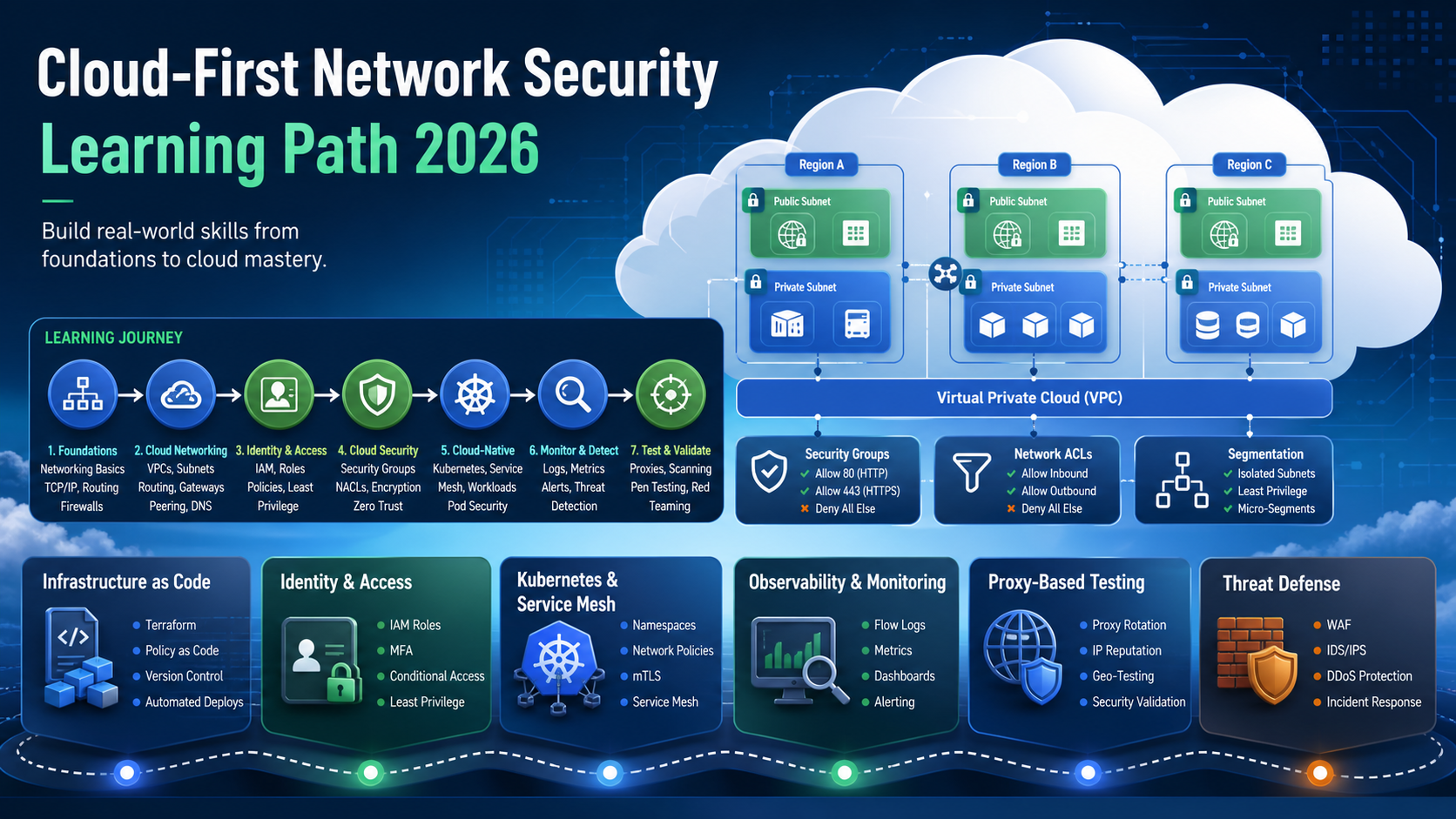
Why learning network security without cloud is a career mistake in 2026. Traditional network security training programs still focus heavily on on-premises infrastructure, physical firewalls, and classic perimeter defense models. But the reality for IT professionals entering the field or updating their skills is stark: most production workloads now run in cloud environments, and the network security challenges they present are fundamentally different from traditional data centers.
This article was prepared for practitioners who care about routing quality, operational reliability, and the real-world tradeoffs behind IP privacy, cloud security, email verification, and automation workflows.
For official technical background, see IANA number resources, ARIN IPv4 resources, RFC 791 Internet Protocol, MDN X-Forwarded-For reference.
Why Learning Network Security Without Cloud Is a Career Mistake in 2026
The problem is that traditional network security training ignores cloud infrastructure. Courses built around Cisco routers, physical switches, and DMZ architectures provide foundational knowledge, but they leave critical gaps when it comes to managing security groups, understanding cloud-native service meshes, or securing ephemeral workloads that spin up and down in minutes.
This article presents a modern approach prioritizing cloud security from day one. Instead of learning cloud as an afterthought or an advanced topic, IT professionals should now structure their learning paths to emphasize cloud networking and security principles early, then backfill traditional concepts where they remain relevant.
Cloud Networking Fundamentals for Security Professionals
Cloud networking operates on different assumptions than traditional networks. Understanding these differences is the first step in building a cloud-first security skillset.
Virtual Networks and Software-Defined Infrastructure
In cloud environments, networks are defined in code rather than configured on physical hardware. Virtual Private Clouds (VPCs) in AWS, Virtual Networks (VNets) in Azure, and VPCs in Google Cloud all abstract networking into software-defined constructs that security professionals must understand:
- Subnets are logical divisions of IP address space, not physical cable runs
- Route tables control traffic flow through software configuration, not physical routing hardware
- Network Address Translation (NAT) happens at gateways defined in cloud consoles, not physical NAT devices
- Peering connections link networks across regions or accounts without physical interconnects
For security professionals, this shift means network segmentation strategies must account for infrastructure as code, version control, and automated deployment pipelines. A misconfigured route table deployed through Terraform can expose entire application tiers instantly.
Security Groups and Network Access Control Lists
Cloud platforms replace traditional firewall rules with security groups and network ACLs:
Security Groups act as stateful firewalls at the instance or workload level. They define allowed inbound and outbound traffic based on protocol, port, and source/destination IP ranges. Unlike physical firewalls with complex rule chains, security groups apply to specific compute resources and follow the resource as it moves or scales.
Network ACLs provide stateless filtering at the subnet level. They evaluate traffic entering or leaving a subnet without tracking connection state, making them useful for broad deny rules but less flexible than security groups.
Security professionals must understand the interaction between these layers. A permissive network ACL combined with restrictive security groups creates different risk profiles than the reverse configuration. Testing these combinations requires cloud-native tools and workflows, not traditional packet capture analysis on physical switches.
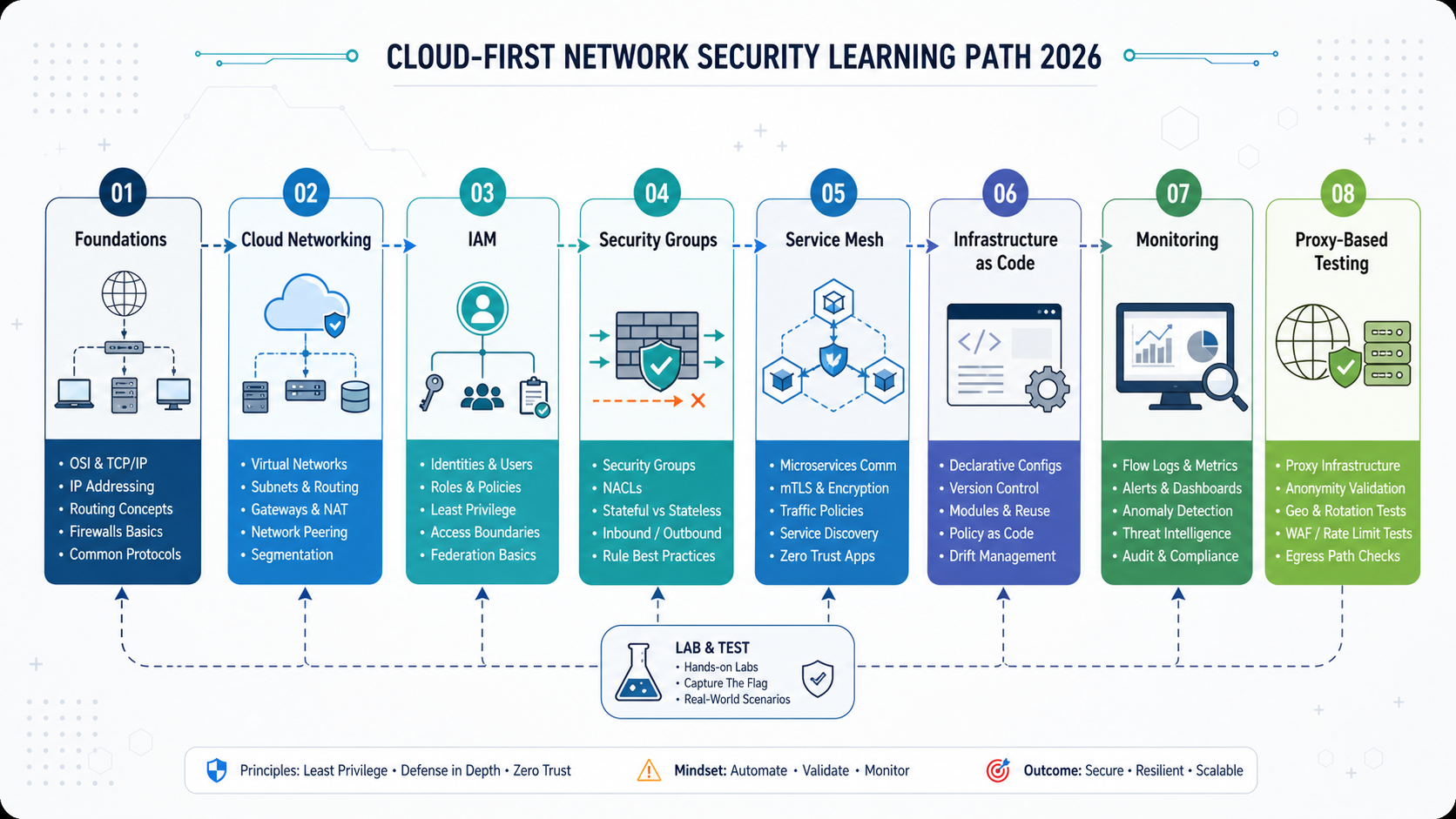
Identity and Access Management Integration
Cloud networking security extends beyond packet filtering to include identity-based access controls. AWS IAM policies, Azure RBAC, and Google Cloud IAM determine not just who can access resources, but who can modify network configurations.
A security professional with traditional network training might secure every firewall rule perfectly but overlook IAM policies that allow developers to modify security groups directly. Cloud-first security learning must include understanding how identity, networking, and compute security intersect.
Service Meshes and Microservices Communication
Modern cloud applications often use service meshes like Istio, Linkerd, or AWS App Mesh to manage communication between microservices. These systems handle:
- Mutual TLS authentication between services
- Fine-grained authorization policies
- Traffic routing and load balancing
- Observability and telemetry
Traditional network security training does not cover these application-layer networking patterns. Security professionals need to understand how service meshes implement zero-trust networking principles within Kubernetes clusters or containerized environments.
Explore LycheeIP Proxy Infrastructure
Serverless and Ephemeral Workloads
Serverless functions, containers, and auto-scaling groups create network security challenges that did not exist in traditional infrastructure:
- Workloads appear and disappear based on demand
- IP addresses change constantly
- Network perimeters become fluid
- Traditional network monitoring tools struggle to track ephemeral resources
Cloud-first security training must address how to secure these dynamic environments using tags, labels, and identity-based policies rather than static IP-based rules.
Traditional Network Security Concepts That Still Matter
While cloud networking introduces new paradigms, many traditional network security concepts remain foundational. The key is understanding which principles transfer directly, which require adaptation, and which become less relevant.
The OSI Model and TCP/IP Stack
Understanding how network protocols work at different layers remains essential. Cloud networking still relies on IP addressing, TCP connections, and UDP datagrams. Security professionals need this foundation to:
Cloud Security Fundamentals Video
- Troubleshoot connectivity issues between cloud resources
- Understand how load balancers distribute traffic
- Configure appropriate security group rules
- Analyze network flow logs effectively
The difference is that cloud platforms abstract much of the physical and data link layer complexity, allowing security professionals to focus more on network, transport, and application layers.
Encryption and VPN Concepts
Traditional VPN technologies remain relevant for hybrid cloud architectures. Many organizations use site-to-site VPNs to connect on-premises data centers to cloud VPCs. Understanding IPsec, tunneling protocols, and encryption standards helps security professionals:
- Configure secure hybrid cloud connections
- Troubleshoot VPN connectivity issues
- Evaluate managed VPN services versus custom implementations
- Implement client VPN access for remote workers
Cloud platforms also introduce managed VPN services that simplify configuration but require understanding the underlying principles to use effectively.
Network Segmentation and Defense in Depth
The principle of defense in depth translates directly to cloud environments. Security professionals should apply multiple layers of controls:
- Network-level controls through security groups and ACLs
- Application-level controls through web application firewalls
- Data-level controls through encryption and access policies
- Identity-level controls through IAM and authentication systems
Cloud environments make it easier to implement micro-segmentation, isolating individual workloads or application components. This capability extends traditional segmentation strategies but requires understanding how to apply them in software-defined infrastructure.
Intrusion Detection and Prevention
Traditional IDS/IPS concepts remain valuable, but their implementation shifts in cloud environments:
- Network-based detection moves from physical appliances to cloud-native services like AWS GuardDuty, Azure Sentinel, or Google Cloud Security Command Center
- Host-based detection focuses on container and instance-level monitoring
- Flow log analysis replaces packet capture in many scenarios
Security professionals need to understand what traditional IDS/IPS systems detected and how cloud-native tools provide similar or enhanced capabilities.
DDoS Protection
Distributed denial of service attacks remain a threat in cloud environments. Understanding DDoS attack vectors helps security professionals:
- Configure cloud-native DDoS protection services
- Design architectures that absorb or deflect attacks
- Implement rate limiting and traffic filtering
- Coordinate with cloud providers during incidents
Cloud platforms offer managed DDoS protection that traditional training rarely covers, but understanding the attack patterns those services mitigate remains important.
Hands-On Cloud Labs for Network Security Practice
Theoretical knowledge alone is insufficient for cloud network security. IT professionals need hands-on experience with cloud platforms, tools, and workflows. Effective learning paths should include structured lab exercises that build practical skills.
Free Tier Cloud Accounts
All major cloud providers offer free tiers that allow learners to experiment without significant costs:
- AWS Free Tier includes 750 hours of EC2 instances, 5GB of S3 storage, and limited use of many services
- Azure Free Account provides 12 months of popular services and always-free services
- Google Cloud Free Tier offers free usage of many products within monthly limits
Security professionals should create accounts on multiple platforms to understand how each implements networking and security concepts differently.
Essential Lab Exercises
A cloud-first security learning path should include these hands-on exercises:
Lab 1: VPC Design and Segmentation
- Create a VPC with public and private subnets
- Configure route tables and internet gateways
- Implement NAT gateways for private subnet internet access
- Test connectivity between subnets
Lab 2: Security Group Configuration
- Deploy web servers in a public subnet
- Configure security groups to allow HTTP/HTTPS from the internet
- Deploy database servers in a private subnet
- Configure security groups to allow database access only from web servers
- Test and verify isolation
Lab 3: Network ACL Implementation
- Add network ACLs to restrict traffic at the subnet level
- Understand stateless filtering behavior
- Compare security group and network ACL effectiveness
Lab 4: Hybrid Cloud Connectivity
- Set up a site-to-site VPN connection
- Configure routing between on-premises and cloud networks
- Test connectivity and troubleshoot issues
Lab 5: Container Network Security
- Deploy a Kubernetes cluster
- Implement network policies to control pod-to-pod communication
- Configure ingress controllers with TLS
- Monitor network traffic between services
Lab 6: Security Monitoring and Logging
- Enable VPC flow logs
- Configure cloud-native security monitoring tools
- Create alerts for suspicious network activity
- Investigate simulated security incidents
Testing and Automation Workflows
Cloud network security increasingly involves automated testing and infrastructure as code. Security professionals should practice:
- Writing security group rules in Terraform or CloudFormation
- Using automated scanning tools to detect misconfigurations
- Implementing CI/CD pipelines that validate network security controls
- Testing security configurations in development environments before production deployment
This is where proxy infrastructure and testing tools become relevant to cloud security workflows. When validating how cloud applications behave from different geographic locations or network conditions, teams often use proxy services to simulate real-world access patterns.
LycheeIP and Cloud-Native Security Testing Workflows
Cloud-native applications often serve users across multiple regions and need to function correctly regardless of where requests originate. Testing these scenarios requires the ability to route traffic through different geographic locations and network paths.
Proxy infrastructure providers like LycheeIP support security testing workflows by allowing teams to:
- Test geo-based access controls by routing requests through residential or datacenter proxies in specific countries
- Verify CDN behavior by accessing applications from different network locations
- Validate rate limiting and DDoS protection by simulating traffic patterns from distributed sources
- Monitor application availability across regions without deploying infrastructure globally
For security professionals building cloud-native testing environments, understanding how proxy infrastructure integrates with automation workflows helps create more comprehensive security validation. Teams can incorporate proxy rotation into penetration testing scripts, load testing scenarios, or continuous monitoring systems.
When using proxy infrastructure for security testing, teams should:
- Clearly document the testing purpose and scope
- Respect rate limits and terms of service
- Use proxies for legitimate testing and monitoring workflows
- Avoid overloading target systems during security assessments
Common Mistakes in Cloud Security Learning Paths
IT professionals transitioning to cloud network security often make predictable mistakes that delay their progress or create knowledge gaps.
Starting with Certifications Instead of Hands-On Practice
Many learners begin by studying for cloud certifications without building practical skills first. While certifications like AWS Certified Security Specialty or Azure Security Engineer Associate validate knowledge, they work best after hands-on experience. Start with lab exercises, then use certification study as a way to formalize and structure knowledge.
Focusing on a Single Cloud Platform
Each cloud provider implements networking and security differently. Learning only AWS creates blind spots when encountering Azure or Google Cloud environments. Multi-cloud skills are increasingly valuable as organizations adopt best-of-breed services across providers.
Neglecting Identity and Access Management
Network security professionals with traditional backgrounds often focus exclusively on network-level controls while underestimating IAM importance. In cloud environments, IAM policies can override network security controls or expose resources regardless of security group configuration. Effective cloud security requires understanding how identity and network security work together.
Ignoring Infrastructure as Code
Manual configuration through cloud consoles does not scale and creates inconsistent environments. Security professionals should learn Terraform, CloudFormation, or similar tools early in their cloud journey. Understanding how to define and version control network security configurations is essential for modern roles.
Overlooking Cost Implications
Cloud resources incur costs, and security controls like VPN connections, load balancers, and data transfer contribute to monthly bills. Effective cloud security professionals understand cost trade-offs and can design secure architectures that remain financially sustainable.
Treating Cloud Security as Optional Add-Ons
Some learners view cloud security as advanced topics to study after mastering basic cloud operations. This approach is backwards. Security should be integrated from the beginning of the learning path, with each lab exercise incorporating security best practices.
Conclusion and Next Steps
The network security field has fundamentally shifted toward cloud-native architectures. Learning traditional network security without cloud context leaves IT professionals unprepared for the majority of roles they will encounter in 2026 and beyond.
A cloud-first learning path does not mean abandoning traditional concepts entirely. The OSI model, encryption principles, segmentation strategies, and defense in depth remain relevant. But these foundational ideas must be applied through cloud-native tools, services, and workflows from the start.
IT professionals updating their skills should prioritize hands-on cloud lab exercises over purely theoretical study. Create free tier accounts, build VPCs, configure security groups, deploy containerized applications, and break things in safe environments. This practical experience builds intuition that certifications and courses alone cannot provide.
The learning path should span multiple cloud platforms, integrate infrastructure as code early, and emphasize the intersection between network security, identity management, and application architecture. These connections define how modern security professionals work.
For those building testing and automation workflows, understanding how proxy infrastructure supports cloud security validation adds another dimension to your skillset. Whether you are testing geo-based access controls, validating global application performance, or simulating distributed traffic patterns, proxy services provide capabilities that complement cloud-native security tools.
The career mistake in 2026 is not learning cloud networking. The opportunity is structuring your learning to prioritize cloud from day one, then filling in traditional concepts as they remain relevant. Start with cloud fundamentals, practice consistently in hands-on labs, and build security thinking into every exercise. This approach positions you for the roles that actually exist in modern infrastructure.
Cloud-First Network Security Learning
What are the most important cloud networking concepts for security professionals?
Virtual Private Clouds (VPCs), security groups, network ACLs, IAM integration, and service meshes represent the core concepts. Understanding how these software-defined networking components work together to secure cloud workloads is more immediately valuable than deep knowledge of physical networking hardware.
Should I learn AWS, Azure, or Google Cloud first?
AWS has the largest market share and most extensive service catalog, making it a logical starting point. However, learning core concepts on any major platform provides transferable knowledge. Consider starting with whichever platform aligns with your current organization or job market in your region, then expanding to others.
How much traditional networking knowledge do I need before learning cloud security?
Basic understanding of IP addressing, subnets, routing, and the TCP/IP stack provides a helpful foundation. You do not need CCNA-level expertise before starting cloud networking. Many cloud-specific concepts make more sense when learned in cloud contexts rather than trying to map them to traditional networking first.
Are cloud security certifications worth pursuing?
Certifications validate knowledge and help with job applications, but they work best after gaining hands-on experience. Build practical skills through labs first, then use certification study to formalize and structure your knowledge. Certifications without practical experience often result in surface-level understanding.
How do I practice cloud security without spending money?
All major cloud providers offer free tiers with limited usage. AWS Free Tier provides 750 hours of EC2 instances monthly for 12 months. Azure and Google Cloud offer similar programs. Use these free resources for learning, and carefully monitor usage to avoid unexpected charges. Set up billing alerts immediately after creating accounts.
What role do proxies play in cloud security testing?
proxy infrastructure allows security teams to test how applications behave when accessed from different geographic locations and network conditions. This helps validate geo-based access controls, CDN configurations, rate limiting, and regional availability. Services like LycheeIP provide proxy infrastructure for these testing workflows.
How important is Kubernetes for network security roles?
Kubernetes has become the dominant container orchestration platform. Understanding Kubernetes networking, network policies, service meshes, and ingress controllers is increasingly important for cloud security roles. Many organizations run significant workloads on Kubernetes, making it essential knowledge rather than optional.
Should I learn infrastructure as code before or after learning cloud networking?
Learn them together. From your first VPC creation, practice defining infrastructure in code using Terraform or CloudFormation. This approach builds good habits early and helps you understand how modern teams actually deploy and manage cloud networks. Manual console configuration is useful for learning but not representative of production workflows.
How do cloud security groups differ from traditional firewalls?
Security groups are stateful, instance-level controls defined in software. They follow resources as they scale or move, unlike physical firewalls tied to specific network locations. Security groups default to deny all traffic and require explicit allow rules. They integrate with cloud IAM systems and can reference other security groups rather than just IP addresses.
What are the biggest security risks when learning cloud networking?
Leaving resources publicly accessible with weak credentials, forgetting to delete lab resources that continue incurring charges, and over-permissive IAM policies that allow unauthorized access represent common risks. Always use billing alerts, enable multi-factor authentication, follow least-privilege principles, and tear down lab environments when not actively using them.
Frequently Asked Questions
What is the main takeaway from Cloud-First Network Security Learning Path 2026?
Cloud-First Network Security Learning Path 2026 matters because operational details around verification, network controls, IP privacy, and routing decisions change the real outcome more than marketing claims do.
Related LycheeIP Guides and Resources
- LycheeIP proxy infrastructure
- Static residential proxies
- Rotating residential proxies
- Datacenter proxies
- Cold email outreach after n8n scraping
- Auto-fill spreadsheets using AI agent web scraping
- LinkedIn lead scraping automation with n8n
- No-code AI agent web scraping
- Scale lead scraping to 100K+ with n8n
- Residential proxy guide
- Mobile proxy guide