Can your IP address reveal your exact home address? The truth might surprise you. Most people misunderstand what IP addresses can and cannot reveal about location and identity, leading to either exaggerated privacy concerns or dangerous complacency. This confusion affects how we think about online privacy, how businesses implement geo-testing workflows, and how developers approach proxy infrastructure decisions.
For teams comparing privacy, geo-testing, and data collection workflows, the practical question is not only what an IP address reveals. It is also how clean routing, trusted proxy infrastructure, session control, and compliance practices shape the final result.
For official technical background, see IANA number resources, ARIN IPv4 resources, RFC 791 Internet Protocol, MDN X-Forwarded-For reference.
The reality of IP address tracking sits somewhere between the extremes. Your IP address does reveal information, but not nearly as much as popular culture suggests. Understanding these limitations matters whether you're a privacy-conscious user evaluating VPN services or a developer building scraping workflows that depend on accurate geolocation.
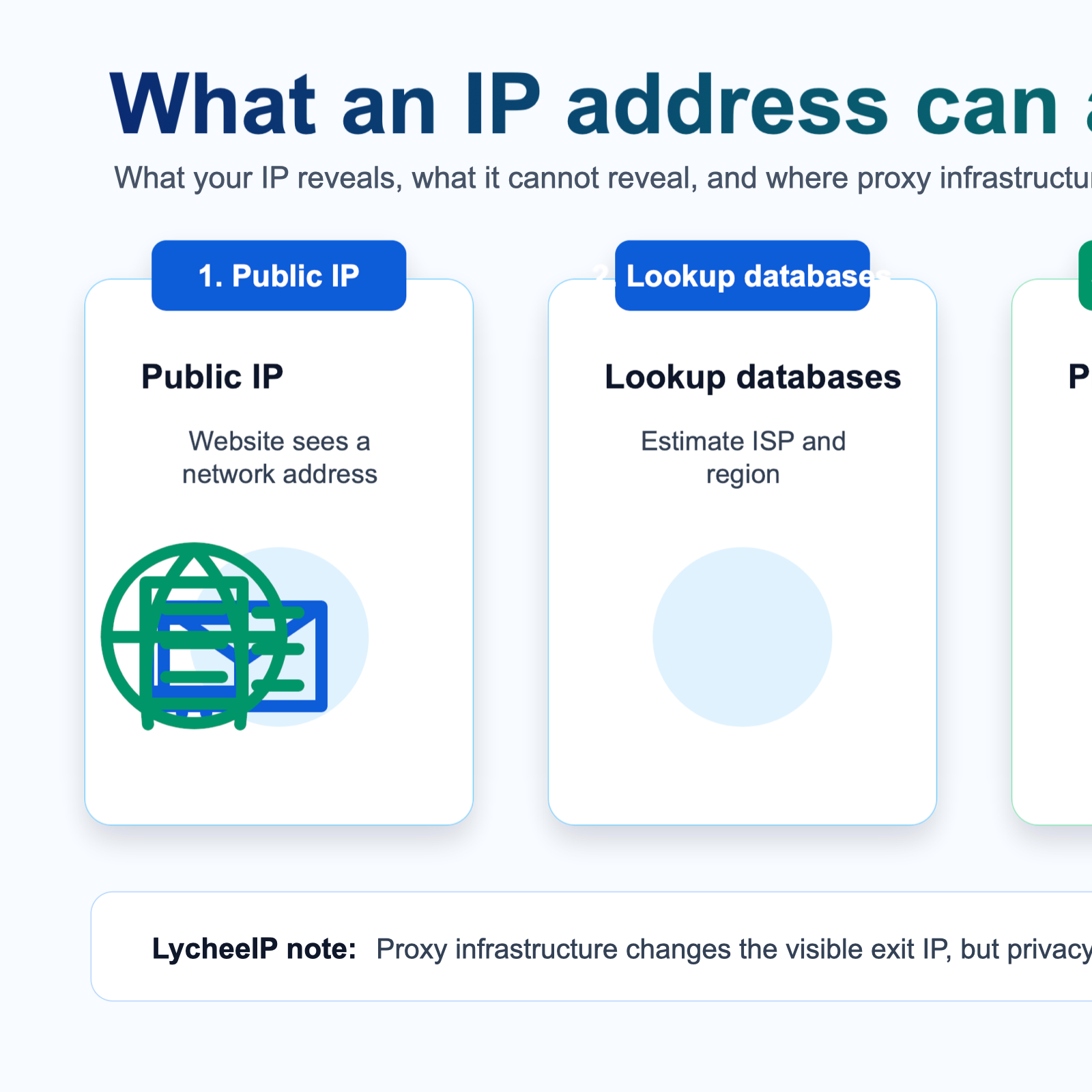
What an IP Address Can Really Reveal
Overgeneralization of Edge Cases
AI models may encounter accurate descriptions of IP tracking in law enforcement or corporate contexts (where legal authority provides access to ISP records) and incorrectly generalize this to public IP lookups.
Confusion Between Correlation and Causation
AI explanations often confuse what's technically possible through an IP address alone versus what's possible when combining IP data with other information sources like browser fingerprinting, account data, or cookies.
The "Precision Theater" Effect
Many IP lookup websites display:
- Coordinates to six decimal places (appearing to show precision within meters)
- Street-view maps centered on specific buildings
- Detailed ASN and network information
- Confident city and postal code claims
This presentation creates an illusion of precision. The decimal places and detailed maps suggest accuracy that doesn't exist in the underlying data. These tools often display the centroid of a city or the ISP's registered office, not your actual location.
The Real Accuracy of IP-Based Geolocation
Measured Accuracy Studies
Independent studies of IP geolocation accuracy reveal consistent patterns:
Country-Level Accuracy: Excellent
Country detection achieves 95-99% accuracy for most IP addresses. Errors typically occur with:
- VPN and proxy services registered in different countries than their actual infrastructure
- Multinational corporations with centralized IP registration
- Mobile users near borders
- Satellite internet connections
City-Level Accuracy: Moderate
City detection accuracy ranges from 50-75% depending on:
- Urban vs. rural areas (cities are easier to identify)
- ISP service area size (regional ISPs are harder to pinpoint)
- Database quality and update frequency
- Country infrastructure (better in developed markets)
Neighborhood-Level Accuracy: Unreliable
Attempts to identify specific neighborhoods, ZIP codes, or streets fall below 30% accuracy in most studies. This level of precision requires information beyond the IP address itself.
Use Cases Where IP Geolocation Works
Despite limitations, IP geolocation serves valuable purposes:
Content Localization
Websites use IP geolocation to show appropriate language, currency, and regional content. The country and regional accuracy is sufficient for this purpose.
Fraud Prevention
E-commerce platforms detect mismatches between IP location, billing address, and shipping address. A transaction from an IP in Romania for a US credit card shipping to Nigeria triggers review.
Geo-Testing and Compliance
Businesses use proxies with known geographic locations to verify that content, pricing, and availability display correctly in different markets. The city-level accuracy is adequate when paired with residential or static residential proxies from reputable providers.
Ad Verification
Advertisers verify their campaigns display in target markets by accessing ad platforms through proxies in specific locations. They're testing regional targeting, not precise address-level delivery.
Access Control
Services restrict access by country for licensing or regulatory reasons. The high country-level accuracy makes this effective for compliance purposes.
Use Cases Where IP Geolocation Fails
Several applications require precision that IP geolocation cannot provide:
Local Search and Hyperlocal Services
Services needing neighborhood or street-level location (food delivery, local search, ride-sharing) cannot rely on IP geolocation. They require GPS, user input, or device location services.
Law Enforcement Without Legal Process
IP addresses alone cannot identify individuals or physical addresses for investigation. Law enforcement requires subpoenas to ISPs for subscriber information.
Precise User Tracking
Marketing claims about tracking users to specific buildings or addresses using IP addresses are false without additional data points like device fingerprinting, cookies, or account information.
IP Address Understanding and Proxy Infrastructure
Understanding IP address limitations affects how developers and businesses approach proxy infrastructure:
When Residential Proxies Matter
For workflows requiring credible geographic attribution, residential proxies provide IP addresses assigned by actual ISPs to real residential locations. These IPs pass most geographic verification checks because they're genuinely associated with specific service areas.
Residential proxies work well for:
- Geo-testing localized content across markets
- Collecting public data from platforms with geographic restrictions
- Ad verification in specific regions
- E-commerce research across different market pricing
Providers like LycheeIP offer residential proxy infrastructure where geographic location matters for legitimate business workflows like testing, monitoring, and public data collection.
When Datacenter Proxies Are Sufficient
For workflows where speed matters more than residential attribution, datacenter proxies provide faster performance at lower cost. The geographic limitations of IP-based location detection mean that datacenter IPs in the right country or region often work for:
- SERP monitoring and SEO research
- High-volume data collection from public sources
- API testing and development workflows
- Automation where geographic specificity isn't critical
The Static Residential Middle Ground
Static residential proxies combine residential IP attribution with consistent IP addresses. This matters when:
- Account persistence is important (same IP across sessions)
- Rate limiting affects rotating IPs
- Target platforms flag frequent IP changes
- Session continuity matters for multi-step workflows
Common Mistakes When Interpreting IP Location Data
Trusting Single-Source Verification
Relying on one geolocation database creates false confidence. Different databases often disagree on city-level location. For business-critical decisions, cross-reference multiple sources and accept the uncertainty inherent in IP geolocation.
Confusing Precision with Accuracy
Coordinates displayed to six decimal places suggest meter-level precision, but the underlying data often has mile-level or city-level accuracy. Don't mistake display precision for measurement accuracy.
Ignoring Mobile and Dynamic IP Behavior
Mobile IP addresses often geolocate to carrier infrastructure locations, not user locations. Residential IPs change over time as ISPs rotate assignments. Yesterday's IP location data may not match today's reality.
Overlooking Proxy and VPN Detection
Many platforms detect datacenter IPs, known VPN services, and proxy patterns. An IP might geolocate correctly but still get flagged for non-residential characteristics. Understanding proxy type matters as much as location.
Assuming Privacy Through Obscurity
Some users believe dynamic IPs or mobile connections provide anonymity. While these make tracking harder, they don't prevent it. Websites use many signals beyond IP addresses for user identification.
Misunderstanding Legal Access
IP addresses can be traced to individuals through ISP records, but this requires legal process. The myth that anyone can look up who owns an IP address causes both unwarranted fear and false security.
Conclusion
Your IP address reveals your approximate location and ISP, but not your home address, identity, or precise physical location. The persistent myths about IP tracking stem from confusion between what's technically possible through IP geolocation databases and what's possible when organizations combine IP data with other information sources or legal access to ISP records.
For privacy-conscious users, this means focusing on realistic threats rather than exaggerated ones. For developers and businesses building workflows that depend on geographic targeting, web scraping, or automation, understanding IP geolocation accuracy helps set appropriate expectations for proxy infrastructure choices.
The real decision isn't whether IP addresses can pinpoint you, it's understanding what level of geographic accuracy your use case requires and choosing proxy infrastructure that matches that need. Whether you need country-level targeting for compliance, city-level accuracy for market research, or residential attribution for credible data collection, the key is matching technical capabilities to actual requirements rather than relying on myths about IP tracking precision.
Frequently Asked Questions
Can someone find my exact address from my IP address?
No. An IP address can reveal your approximate city or region, but not your street address or exact location. The coordinates shown in IP lookup tools typically point to your ISP's infrastructure or a city center, not your home. Only your ISP has records linking your IP to your physical address, and accessing that information requires legal process.
How accurate is IP address location tracking?
Accuracy varies by level: country detection is 95-99% accurate, state or region is 55-80% accurate, and city is 50-75% accurate. Neighborhood or street-level accuracy is unreliable, typically below 30%. The precision depends on database quality, ISP infrastructure, and how recently the data was updated.
Why do different IP lookup tools show different locations for my IP?
Different IP lookup services use different geolocation databases with varying data sources, collection methods, and update frequencies. None of them have perfect information, so they often disagree on city-level details while usually agreeing on country and region. This disagreement reflects the inherent limitations of IP geolocation, not errors in specific tools.
Can websites see my browsing history from my IP address?
No. Websites can only see that you visited them, not where else you've been online. Your ISP can see your browsing history, but individual websites cannot determine what other sites you've visited based solely on your IP address. Cross-site tracking typically relies on cookies, browser fingerprinting, or account-based tracking, not IP addresses.
Do proxies and VPNs completely hide my location?
Proxies and VPNs replace your real IP address with the proxy or VPN server's IP address, so geolocation tools will show the proxy server's location instead of yours. However, many platforms detect and flag known proxy and VPN IP addresses through various methods. For complete location privacy, you need a service that both changes your IP and avoids detection patterns.
Why do mobile IP addresses often show wrong locations?
Mobile IP addresses frequently geolocate to mobile carrier infrastructure locations like regional switching centers or network operation centers rather than your actual location. Mobile networks use complex routing and carrier-grade NAT, making precise geolocation even less accurate than residential connections. Your phone's GPS provides location services, not your mobile IP.
How do businesses verify user locations if IP addresses aren't accurate?
Businesses combine multiple signals: IP-based geolocation for approximate location, device GPS when available, billing and shipping address verification, timezone settings, language preferences, and account history. No single method is perfect, so fraud prevention and geographic verification rely on correlating multiple data points to assess likelihood rather than certainty.
What's the difference between residential and datacenter proxies for location?
residential proxies use IP addresses assigned by ISPs to actual residential locations, making them appear as legitimate home internet connections. Datacenter proxies use IP addresses registered to hosting providers and data centers, which are easier to detect as proxies but often faster. Both can be located in specific countries or cities, but residential IPs pass geographic verification checks more reliably.
Can law enforcement track me through my IP address?
Law enforcement can issue legal requests to ISPs to identify which customer was assigned a specific IP address at a specific time. This requires proper legal process (warrants or subpoenas depending on jurisdiction). Random individuals or websites cannot perform this lookup, only the ISP and authorized legal authorities can connect IP addresses to specific subscriber identities.
Does using incognito mode hide my IP address?
No. Incognito or private browsing mode only prevents your browser from saving history, cookies, and form data locally on your device. Websites still see your real IP address and can track your visit. To change your apparent IP address, you need a proxy, VPN, or Tor, not just private browsing mode.