Smart Proxy Server: The Intelligent Proxy for Geo Access, IP Rotation, and Search Engine Optimisation
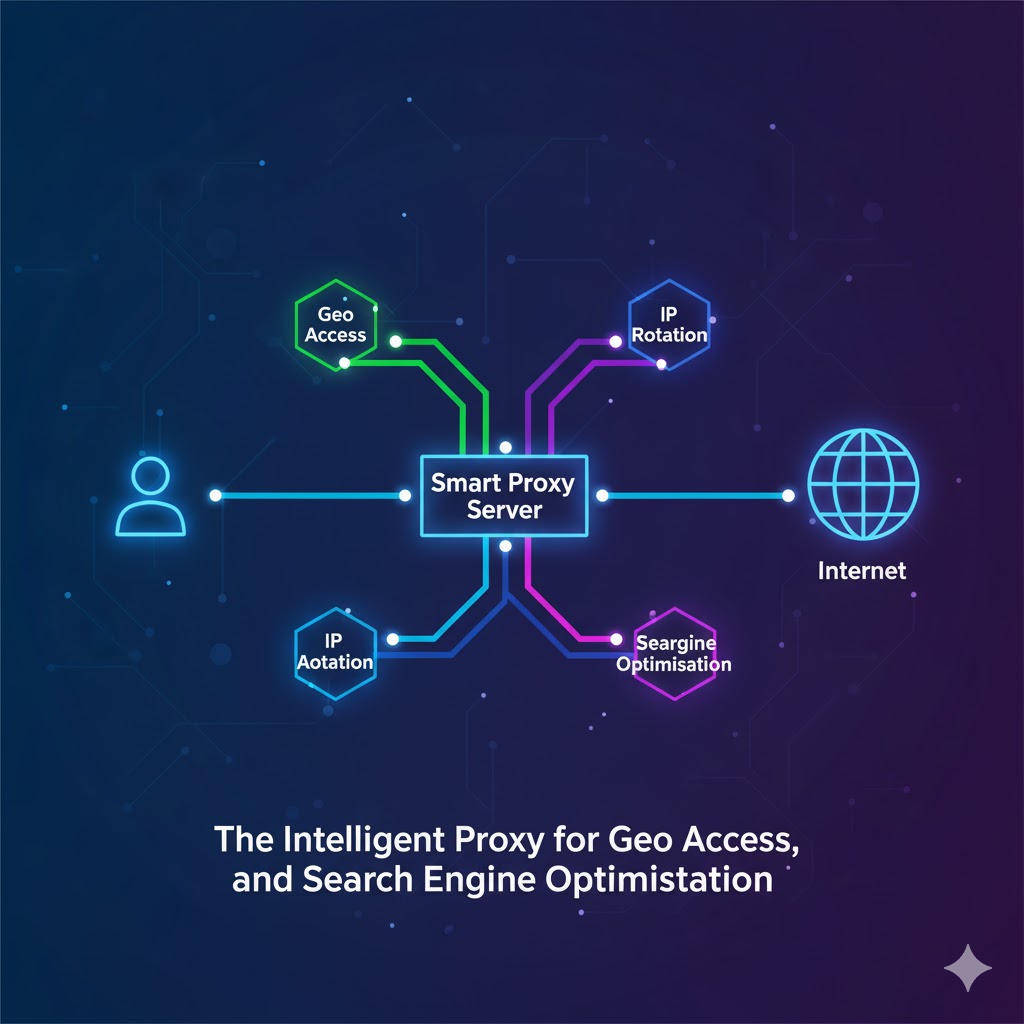
A smart proxy server is an advanced intermediary that automates the complex tasks of managing IP addresses, locations, and sessions for large-scale web data collection. For developers and data teams, an intelligent proxy is a critical piece of infrastructure that replaces manual IP juggling with a single, powerful gateway, enabling more reliable and efficient workflows.
This article provides a practical look at the smart proxy server. We will explain what it is, how it differs from tools like VPNs and Smart DNS, and why its features are essential for tasks like search engine optimisation. We will also cover implementation, best practices, and how to build a resilient architecture around a smart Proxy.
What is a smart proxy server?
A smart proxy server is a forward proxy that adds a layer of automation to manage IP addresses and routing rules. Instead of providing a single, static IP, a smart Proxy gives you access to a large pool of IPs and automatically handles tasks like ip rotation, session management, and geo-targeting based on the rules you configure.
How does an intelligent proxy route and mask traffic?
An intelligent proxy routes your traffic by accepting your connection at a gateway server and then forwarding it to the target website from an IP address chosen from its pool. This process masks your original IP, making the request appear to come from the proxy's IP. The "smart" part is the logic that decides which IP to use for each request to maximize success rates.
What is the forward proxy vs reverse proxy difference?
It is important to understand that a smart proxy server is a type of forward proxy.
- Forward Proxy: Sits between a user (or a bot) and the internet, acting on behalf of the user. This is the model used by a proxy for smart data collection.
- Reverse Proxy: Sits in front of a web server, acting on behalf of the server to manage incoming traffic.
Scale your data collection efficiently using LycheeIP's rotating gateway
How is a smart proxy server different from Smart DNS and a VPN?
A smart proxy server differs from Smart DNS and a VPN in its core function and use case. A smart proxy server is for granular control of application traffic, Smart DNS is for simple geo-unblocking, and a VPN is for overall device privacy.
| Technology | Primary Function | Primary Use Case |
| Smart Proxy Server | Manages and rotates IP addresses for specific applications. | Data collection, search engine optimisation, ad verification. |
| Smart DNS | Reroutes DNS requests to a different region. | To bypass geo restrictions for streaming media. |
| VPN | Encrypts and routes all device traffic through a tunnel. | Securing connections on public Wi-Fi, general privacy. |
When should you use Smart DNS to bypass geo restrictions?
You should use Smart DNS when your only goal is to bypass geo restrictions for media streaming services. It is typically faster than a VPN because it does not encrypt your traffic, but it also offers no privacy benefits and does not change your IP address.
Why VPN encryption changes performance and privacy
A VPN provides the highest level of privacy by encrypting all your device's traffic. This VPN encryption process adds overhead, which can slow down your connection. A smart proxy server does not inherently encrypt traffic, but it works seamlessly with HTTPS to provide security.
Which features matter most in a smart Proxy for smart automation?
You should prioritize features that provide control, reliability, and observability for your automated workflows. An effective intelligent proxy is more than just a collection of IPs; it is a full-featured platform.
IP rotation, sticky sessions, pools, and city-level targeting
- IP Rotation: The ability to get a new IP for every request or at set intervals. This is a core feature for any smart proxy server.
- Sticky Sessions: The option to keep the same IP address for a period of time, which is essential for multi-step processes.
- IP Pool Diversity: Access to different types of IPs (residential, datacenter, mobile) from a wide range of locations.
- Granular Geo-Targeting: The ability to select IPs from specific countries, states, and cities to bypass geo restrictions for testing.
Authentication, allowlists, logs, and dashboards
A professional proxy for smart workflows should also provide robust management tools. This includes secure authentication methods, IP allowlists, detailed usage logs, and a dashboard for monitoring performance and costs.
Scale your data collection efficiently using LycheeIP's rotating gateway
How does IP rotation work and when should you use it?
IP rotation works by automatically assigning a different IP address from the provider's pool to each of your requests or sessions. You should use it to distribute your traffic across many different identities to avoid triggering rate limits and IP-based blocks.
Rotating vs static/ISP proxies and session best practices
- Rotating Mode: Use this for large-scale data collection where each request should be independent. This is the classic use case for ip rotation.
- Sticky/Static Mode: Use this for tasks that require a consistent session, like managing an online account or navigating a checkout process.
Managing CAPTCHAs, 429s, and retries
Even with a smart proxy server, you will encounter challenges. A good strategy involves:
- Implementing exponential backoff when you receive a 429 "Too Many Requests" error.
- Building logic to detect CAPTCHAs and either solve them or rotate to a new IP.
- Using a high-quality IP pool to minimize these issues in the first place.
Why do search engine optimisation teams use a smart proxy server?
Search engine optimisation teams use a smart proxy server to gather accurate, unbiased data about how search engines see and rank their websites from different locations around the world. It is an indispensable tool for any serious search engine optimisation strategy.
Local SERP, rank checks, and content QA in web design and search engine optimisation
For search engine optimisation, a smart Proxy allows teams to:
- Check Local Rankings: Accurately see how they rank for keywords in specific cities or countries.
- Audit SERPs: Analyze the search engine results pages to understand the competitive landscape in different markets.
- QA Localized Content: Verify that the correct version of a website is being shown to users in different regions.
In the world of web design and search engine optimisation, a smart proxy server is also used to test page speed and user experience from various network locations.
Programmatic site audits across regions
An intelligent proxy enables large-scale, automated site audits. A technical search engine optimisation team can run a crawler through a smart proxy server to check for issues like broken links, redirect chains, and hreflang implementation across all international versions of their site.
What architectures fit data engineers using an intelligent proxy?
Data engineers fit an intelligent proxy into a resilient, scalable architecture designed for high-volume data collection. The goal is to build a system that can handle failures gracefully and operate continuously.
The queue, fetcher, retry, rotate pattern
A common and effective architecture involves:
- A Queue: A message queue (like RabbitMQ or SQS) holds the list of URLs or tasks to be processed.
- A Fetcher: A pool of worker processes that consume tasks from the queue and make requests through the intelligent proxy.
- A Retry Mechanism: Logic to handle failed requests, typically with exponential backoff.
- A Rotation Strategy: Rules to trigger an ip rotation or change regions when a certain error threshold is met.
A developer-first provider like LycheeIP is ideal for this architecture. Our simple, lightweight gateway endpoint can be easily integrated into your fetcher, giving you control over a massive, clean IP pool without the complexity of a heavy "unlocker" application.
Observability: success rate and error taxonomies
A robust pipeline must be observable. You should log every request and its outcome, tracking metrics like success rate, latency, and the types of errors you are receiving. This data is critical for optimizing your proxy for smart, automated workflows.
Which providers and pricing models should you evaluate?
You should evaluate providers based on the quality of their IP pool, the flexibility of their features, and the transparency of their pricing. There is no one-size-fits-all "best" provider; the right choice depends on your specific needs.
GB pricing vs ports; residential vs datacenter vs mobile
- Pricing: Models typically fall into per-gigabyte billing (common for residential IPs) or per-port/per-IP billing (common for datacenter IPs).
- IP Types: Choose the IP type that matches your target's sensitivity. Datacenter is cheap and fast, while residential offers the highest trust.
SLAs, support, and trial policies
For professional use, look for providers that offer a Service Level Agreement (SLA) for uptime, responsive customer support, and a free trial or money-back guarantee. This allows you to test the service with your actual workload before making a commitment.
Scale your data collection efficiently using LycheeIP's rotating gateway
How do you implement a proxy for smart workflows in browsers and code?
You can implement a proxy for smart workflows using either browser extensions for manual testing or by integrating the proxy directly into your code for automation.
Chrome/Firefox extensions and PAC files
For manual QA and search engine optimisation checks, a browser extension like FoxyProxy is a great way to quickly switch between different proxy profiles. For more advanced setups, a PAC (Proxy Auto-Configuration) file can be used to automatically route traffic for specific domains through your smart Proxy.
Quick code examples (cURL, Python, Node.js)
cURL:
Bash
curl --proxy http://user:pass@gw.provider.com:port https://api.ipify.org
Python:
Python
import requests
proxies = {"https": "http://user:pass@gw.provider.com:port"}
response = requests.get("https://api.ipify.org", proxies=proxies)
print(response.text)
Node.js:
JavaScript
const axios = require('axios');
const { HttpsProxyAgent } = require('https-proxy-agent');
const agent = new HttpsProxyAgent('http://user:pass@gw.provider.com:port');
axios.get('https://api.ipify.org', { httpsAgent: agent }).then(res => {
console.log(res.data);
});
When should you worry about compliance and ethics?
You should worry about compliance and ethics from the very beginning of any data collection project. Using a smart proxy server is a powerful capability that must be wielded responsibly.
Respecting ToS, robots.txt, and PII boundaries
Always review and respect a website's Terms of Service and robots.txt file. Do not collect personally identifiable information (PII) without a legal basis, and only collect public data.
Corporate governance tips
In a team setting, establish clear guidelines for proxy usage. Maintain an audit trail of all data collection activities and ensure that everyone on the team understands the compliance requirements.
Why do some sites still block an intelligent proxy, and how do you fix it?
Some sites still block an intelligent proxy because they use advanced bot detection techniques that look beyond just the IP address. A high-quality proxy is the first line of defense, but it is not a complete solution on its own.
Fingerprints, headers, and headless browsers
Modern anti-bot systems analyze browser fingerprints, TLS/JA3 fingerprints, and request headers. To avoid detection, you must ensure that your requests are indistinguishable from those of a real browser. This often involves using a headless browser and carefully managing your request headers.
Escalation: rotate pools, change regions
If you are still being blocked, you can try escalating your strategy. This might involve switching from datacenter to residential IPs, changing your target region, or further slowing down your request rate. The goal is to find a combination of factors that allows you to operate successfully.
Scale your data collection efficiently using LycheeIP's rotating gateway
Frequently Asked Questions:
1. What is the difference between a smart proxy server and a regular proxy?
A regular proxy typically provides a single, static IP address. A smart proxy server provides access to a large pool of IPs and automates tasks like ip rotation and geo-targeting through a single gateway, making it an intelligent proxy for scalable tasks.
2. How does a smart proxy help with search engine optimisation?
A smart Proxy helps with search engine optimisation by allowing you to accurately check search engine rankings, audit SERPs, and test localized content from any geographic location, providing unbiased data.
3. Can a smart proxy server bypass all geo restrictions?
A smart proxy server is very effective at helping you bypass geo restrictions for data collection and testing by providing you with an IP address from the desired country. However, no tool can guarantee 100% success against all sites.
4. What is IP rotation and why is it important?
IP rotation is the process of automatically changing the IP address used for your requests. It is important because it prevents your activity from being traced to a single IP, which helps avoid rate limits and blocks.
5. Is a smart proxy server the same as a VPN?
No. A smart proxy server is a tool for managing application-level traffic for data collection, while a VPN is a privacy tool that encrypts and routes all the traffic from your entire device.
6. Do I need to be a developer to use an intelligent proxy?
While an intelligent proxy is designed with developers in mind, tools like browser extensions make it accessible for non-developers to use for tasks like manual QA testing for web design and search engine optimisation.