
Introduction
Traffic correlation can defeat Tor. Here's how timing attacks unmask 'anonymous' users.
Even sophisticated privacy setups can be defeated through timing analysis and fingerprinting. Many security professionals and advanced privacy users assume that masking an IP address through Tor, VPNs, or proxy networks provides complete anonymity. The reality is far more complex. Advanced de-anonymization techniques leverage traffic patterns, timing analysis, and browser characteristics to identify users even when their IP addresses are obscured. Understanding these methods is essential for security professionals building threat models, privacy-focused teams designing protection strategies, and organizations evaluating their anonymity requirements.
This technical deep-dive examines the most effective de-anonymization methods that bypass IP-based privacy measures, from traffic correlation attacks against Tor to browser fingerprinting that persists across IP changes.
How Traffic Correlation Analysis Works Against Tor
Traffic correlation analysis represents one of the most powerful techniques for de-anonymizing users on privacy networks like Tor. The fundamental principle is deceptively simple: by observing traffic entering and exiting the anonymity network, an adversary can match patterns to identify which entry traffic corresponds to which exit traffic.
The Mechanics of Traffic Correlation
Tor routes traffic through three relay nodes: an entry guard, a middle relay, and an exit node. Each relay only knows the previous and next hop, theoretically preventing any single node from linking the user to their destination. However, an adversary who can observe both the traffic entering the Tor network from a user and the traffic exiting to a destination can perform correlation analysis.
The attack works by analyzing several characteristics:
Timing patterns: The intervals between packets remain relatively consistent as they traverse the network. Even with random delays introduced by Tor relays, statistical analysis of packet timing can reveal correlations between entry and exit streams.
Packet size sequences: While Tor pads some traffic, the sequence of packet sizes often creates a distinctive signature. A user downloading a specific web page generates a characteristic pattern of request and response sizes that persists through the network.
Traffic volume: The total volume of data transferred in a session creates another correlation point. A user downloading a large file produces a volume signature visible at both entry and exit points.
Bidirectional flow characteristics: Interactive sessions like web browsing create distinctive back-and-forth patterns. The rhythm of requests and responses forms a temporal signature that survives network traversal.
Practical Implementation of Correlation Attacks
An adversary implementing traffic correlation typically requires observation points at both network boundaries. This could mean:
The analysis process involves collecting traffic metadata (timing, size, direction) without necessarily accessing encrypted content. Statistical correlation algorithms then match entry streams to exit streams based on similarity scores across multiple features.
Research has demonstrated that correlation attacks can achieve high accuracy rates. Studies show that with as little as a few minutes of observed traffic, correlation analysis can successfully link users to their destinations with 90% or higher accuracy under certain conditions.
- Controlling both entry and exit nodes in the Tor network
- Compromising internet service providers at the user's location and the destination
- Operating monitoring infrastructure at internet exchange points
- Combining node operation with network-level observation
Defenses and Limitations
Defending against traffic correlation requires breaking the statistical relationship between entry and exit traffic. Techniques include:
Constant-rate traffic shaping: Sending data at a fixed rate with dummy padding eliminates timing and volume signatures but creates significant overhead.
Random delays: Introducing substantial random delays at each hop reduces correlation but severely impacts usability.
Cover traffic: Generating fake traffic to obscure real communication patterns increases network load and still may not fully defeat advanced correlation algorithms.
Path selection strategies: Using guard nodes from different network locations and avoiding certain exit nodes reduces some correlation risks but cannot eliminate them entirely.
The fundamental challenge is that effective defenses typically impose severe performance penalties or require network-wide changes that are impractical for existing anonymity networks.
Browser Fingerprinting Techniques That Bypass IP Masking
While traffic correlation attacks target network-level patterns, browser fingerprinting operates at the application layer, creating persistent identifiers that survive IP address changes entirely. This makes fingerprinting particularly dangerous for users who believe IP masking provides adequate anonymity.
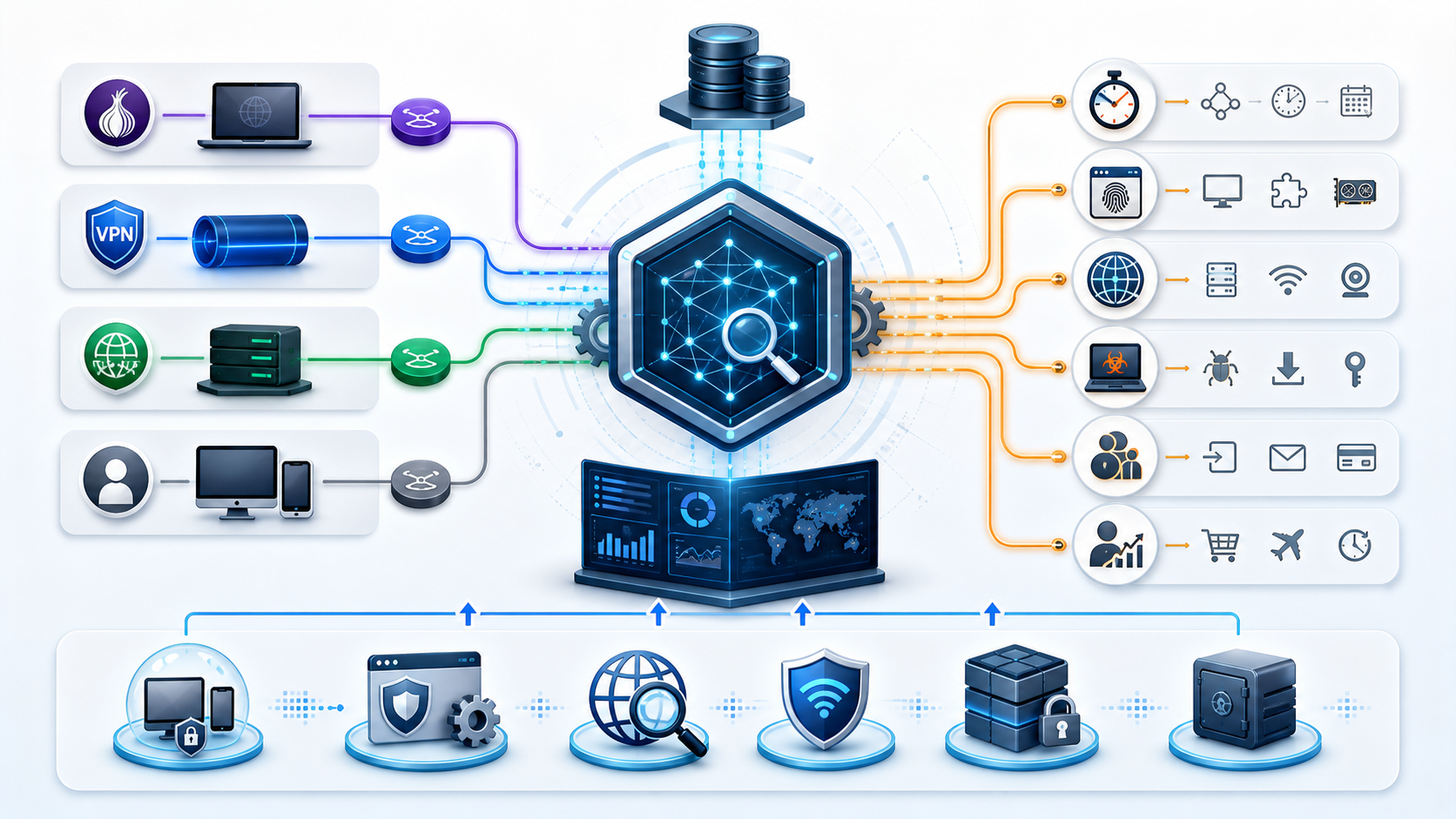
Components of Browser Fingerprints
A browser fingerprint combines dozens of characteristics exposed through standard web APIs and browser behavior. Unlike cookies that users can delete, fingerprints are generated from inherent browser and system properties.
Canvas fingerprinting: The HTML5 canvas API allows websites to render graphics in the browser. Subtle differences in how graphics hardware and drivers render specific shapes and text create unique signatures. Even identical browser versions on similar systems produce slightly different canvas outputs due to hardware variations, font rendering differences, and operating system characteristics.
WebGL fingerprinting: WebGL exposes detailed information about graphics hardware, drivers, and rendering capabilities. The combination of GPU model, driver version, supported extensions, and rendering characteristics creates a highly distinctive fingerprint. Differences in how different GPUs render specific 3D scenes provide additional entropy.
Audio context fingerprinting: The Web Audio API processes sound in ways that vary slightly between systems. By generating and analyzing audio signals, websites can detect differences in audio processing that reflect hardware and software variations.
Browser configuration: Dozens of configuration details combine to create uniqueness:
Behavioral fingerprinting: How users interact with websites creates additional identifying patterns:
- Screen resolution and color depth
- Installed fonts (detectable through measurement techniques)
- Timezone and language settings
- Browser plugins and extensions
- HTTP headers (User-Agent, Accept headers, etc.)
- Supported MIME types
- Browser feature detection results
- Mouse movement patterns and timing
- Keystroke dynamics and typing rhythms
- Scrolling behavior and speed
- Touch gesture characteristics on mobile devices
Advanced Fingerprinting Techniques
Modern fingerprinting goes beyond simple feature detection to employ sophisticated analysis:
Cross-browser fingerprinting: By identifying characteristics that remain consistent across different browsers on the same device (hardware features, operating system details), fingerprinters can track users even when they switch browsers.
Cross-device fingerprinting: Users who access services from multiple devices can be linked through behavioral patterns, account activity correlation, and shared network characteristics.
Fingerprint evolution tracking: As users update browsers or change settings, their fingerprints evolve. Advanced tracking systems monitor how fingerprints change over time to maintain identity across updates.
Probabilistic fingerprinting: Rather than requiring perfect matches, modern systems use machine learning to calculate probability scores that link similar fingerprints to the same user.
Fingerprinting Resistance Strategies
Defending against fingerprinting requires reducing uniqueness and preventing information leakage:
Browser standardization: Using browsers designed for privacy (Tor Browser, Brave) that standardize configurations across users reduces fingerprint uniqueness. All Tor Browser users present nearly identical fingerprints.
API restrictions: Blocking or limiting access to fingerprinting APIs (canvas, WebGL, audio context) prevents certain techniques but may break website functionality.
Randomization: Some privacy tools inject random noise into fingerprinting APIs, making fingerprints inconsistent across visits. However, the randomization pattern itself can sometimes be fingerprinted.
Extension management: Minimizing browser extensions reduces fingerprint surface area, as extensions modify browser behavior in detectable ways.
Script blocking: Preventing JavaScript execution entirely eliminates most fingerprinting but breaks most modern websites.
The challenge is that effective fingerprint resistance often requires sacrificing either convenience or functionality. Browsers configured for maximum privacy may appear suspicious precisely because their anti-fingerprinting measures are detectable.
Why Timing Patterns Reveal Identity Despite IP Changes
Timing analysis represents perhaps the most difficult de-anonymization vector to defend against because timing is fundamental to network communication. No matter how thoroughly users mask their IP addresses, timing patterns can reveal identity through multiple mechanisms.
Network-Level Timing Attacks
End-to-end timing correlation: As discussed in traffic correlation, the timing relationship between a user's actions and corresponding network events persists through anonymity networks. When a user clicks a link, the resulting traffic appears at the exit node after a relatively predictable delay. Observing both points allows matching.
Website fingerprinting: Each website produces a distinctive pattern of resource loads. The timing and size of these loads creates a signature that can identify which website a user is visiting, even through encrypted connections. Machine learning classifiers trained on website timing patterns can achieve over 90% accuracy in identifying websites through Tor.
Intersection attacks: By observing when a user is active on an anonymity network and correlating this with activity on various services, adversaries can narrow down identity. If activity on a specific forum coincides repeatedly with a particular Tor user's online periods, this correlation suggests linkage.
Application-Level Timing Signals
Authentication timing: Login attempts, session creation, and authentication flows create timing patterns. The interval between initial page load and login submission, or the time taken to type credentials, can be consistent enough to track users across IP changes.
Activity patterns: Users exhibit consistent temporal behavior. They access services at similar times, maintain characteristic session durations, and show regular activity patterns. These behavioral rhythms persist regardless of IP address.
Response timing: How quickly users respond to messages, notifications, or events creates a behavioral timing signature. The distribution of response delays can be distinctive enough for identification.
Timing Attack Scenarios
Consider a security researcher accessing a sensitive whistleblowing platform through Tor. Even with perfect IP anonymity:
An adversary monitoring the entry point (ISP level) and the platform can use timing correlation to link the researcher's true IP to their platform activity despite Tor.
- The timing pattern of their access (late evening in a specific timezone) narrows geographic location
- The interval between their Tor session starting and platform access reveals their workflow
- The pattern of documents they access (timing and sequence) creates a behavioral signature
- Their typing speed and interaction timing are consistent across visits
- Correlation with their absence from other activities during these periods provides additional data points
Mitigating Timing Attacks
Effective timing attack mitigation requires breaking temporal correlations:
Delayed actions: Introducing substantial random delays between user actions and their execution makes correlation harder but severely impacts usability. A 30-second random delay before each action would improve timing resistance but makes interactive use nearly impossible.
Batched communication: Rather than sending traffic immediately, systems can batch communications and send them at fixed intervals. This decouples user actions from network traffic timing but introduces latency.
Cover traffic: Continuously sending traffic even when idle obscures the timing of real activity. This approach consumes significant bandwidth and resources.
Varied access patterns: Consciously varying access times, session durations, and interaction patterns reduces predictability but requires disciplined operational security.
Tool switching: Regularly switching between different anonymity tools and paths adds noise to patterns but increases complexity and potential mistakes.
The fundamental problem is that timing is intrinsic to communication. Any interactive system requires temporal coordination between parties, and this coordination inevitably creates patterns. Completely eliminating timing correlations would require communication delays so long that interactive use becomes impractical.
Multi-Layer Timing Correlation
Sophisticated adversaries combine multiple timing vectors:
Machine learning models trained on these combined signals can achieve high accuracy in linking activity to specific users even through multiple layers of IP anonymity.
- Network-level packet timing analysis
- Application-level behavioral timing
- Cross-platform activity correlation
- Long-term pattern analysis
Implications for Proxy Infrastructure and Data Collection
Understanding de-anonymization techniques has direct implications for organizations using proxy infrastructure for legitimate workflows like web scraping, public data collection, and automation.
Explore LycheeIP Proxy Infrastructure
Proxy Infrastructure Considerations
While proxies provide IP rotation for technical workflows, they do not inherently provide the same anonymity goals as Tor or similar privacy networks. Organizations using proxy services for data collection, testing, or research face different threat models:
Session persistence: Many legitimate workflows require maintaining consistent sessions across multiple requests. static residential proxies or session-based proxy pools allow this while providing IP diversity for geo-testing or rate limit management.
Fingerprint management: When conducting e-commerce research, SERP monitoring, or ad verification at scale, managing browser fingerprints becomes as important as IP rotation. Consistent fingerprints across IP changes can trigger anti-bot systems, while inconsistent fingerprints with the same IP may appear equally suspicious.
Timing considerations: Automated scraping workflows that access targets at regular intervals create easily detectable timing patterns. Introducing realistic delays and randomization helps workflows appear more organic.
Responsible Data Collection Practices
Organizations conducting public data collection should consider:
Proxy infrastructure providers like LycheeIP offer various proxy types suited to different workflows. Residential proxies provide IP addresses that appear as regular home users, useful for accessing geo-restricted content or conducting market research. Datacenter proxies offer faster performance for high-volume data collection where residential IPs are not required. static residential proxies combine the legitimacy of residential IPs with session persistence needed for authenticated workflows.
- Respecting website terms of service and robots.txt directives
- Implementing rate limiting to avoid overwhelming target infrastructure
- Using appropriate proxy types (residential vs datacenter) based on use case requirements
- Rotating both IP addresses and browser fingerprints when needed
- Maintaining request patterns that appear organic rather than automated
Developer-Controlled IP Routing
Advanced teams building scraping infrastructure or automation workflows need precise control over IP routing strategies:
Understanding how timing analysis and fingerprinting work helps developers design more resilient data collection systems that avoid detection not through perfect anonymity (often not the goal) but through appearing as legitimate traffic.
- Selecting specific geolocations for regional testing
- Maintaining session persistence for multi-step workflows
- Rotating IPs based on triggers (time, request count, detection)
- Distributing requests across IP pools to simulate organic traffic patterns
- Managing separate IP pools for different projects or clients
Common Mistakes and Considerations
Security professionals and teams building privacy or automation systems frequently encounter these issues:
Overestimating IP Masking
The most common mistake is assuming IP rotation or proxies alone provide adequate anonymity or anti-detection. IP addresses are only one identification vector among many. Rotating IPs while maintaining consistent browser fingerprints, cookies, or authentication tokens provides minimal protection.
Underestimating Passive Monitoring
Many threat models focus on active attacks but neglect passive monitoring capabilities. Nation-state adversaries, large internet service providers, and organizations operating significant infrastructure can perform traffic correlation and timing analysis through passive observation without active intervention.
Neglecting Behavioral Patterns
Users and automated systems both create behavioral signatures through their actions over time. These patterns persist across technical anonymity measures. A user who always accesses certain sites in sequence, or a scraper that processes pages in predictable order, creates timing and behavioral patterns that enable identification.
Inconsistent Operational Security
Mixing anonymous and identified activity from the same location or device creates correlation opportunities. Accessing an anonymized service shortly before or after identified activity, from the same network, provides timing correlation points even if different IPs are used.
Configuration Mistakes
Incorrect proxy configuration, DNS leaks, WebRTC leaks, and browser extension interactions can bypass intended privacy measures. Each layer of the stack (network, browser, application) requires correct configuration to maintain anonymity properties.
Performance Tradeoffs
Effective anti-fingerprinting and timing attack resistance typically impose significant performance costs. Systems designed for maximum anonymity may be impractically slow for many workflows. Organizations must balance privacy requirements against operational needs.
Legal and Ethical Considerations
While understanding de-anonymization techniques is valuable for security professionals, applying these methods raises legal and ethical questions. Attempting to de-anonymize users without authorization may violate privacy laws and ethical norms. Organizations conducting legitimate data collection or research should:
- Ensure activities comply with applicable laws and regulations
- Respect website terms of service
- Avoid techniques that could be considered unauthorized access
- Implement ethical guidelines for data collection and use
Conclusion
Advanced de-anonymization techniques demonstrate that IP masking alone cannot provide robust anonymity. Traffic correlation defeats Tor through statistical analysis of timing and volume patterns. Browser fingerprinting bypasses IP-based privacy by creating persistent identifiers from browser and hardware characteristics. Timing analysis reveals identity through behavioral patterns that persist regardless of IP changes.
For security professionals, understanding these techniques is essential for building accurate threat models and implementing appropriate defenses. For organizations using proxy infrastructure for data collection, scraping, or automation, these concepts inform better system design that balances operational requirements with anti-detection needs.
Effective anonymity requires addressing multiple layers simultaneously: network-level traffic patterns, application-level fingerprints, and behavioral timing signatures. No single countermeasure suffices. Users requiring strong anonymity must accept significant usability costs, while organizations conducting legitimate technical workflows should implement thoughtful combinations of IP rotation, fingerprint management, and timing randomization appropriate to their specific threat models.
The ongoing evolution of both de-anonymization techniques and privacy-enhancing technologies ensures this remains a dynamic field requiring continued attention from security professionals, privacy advocates, and technical teams building resilient systems.
Related LycheeIP Guides and Resources
- <a href="https://www.lycheeip.com/en/home/ip">LycheeIP proxy infrastructure</a>
- <a href="https://www.lycheeip.com/en/ip/static">static residential proxies</a>
- <a href="https://www.lycheeip.com/en/ip/dynamic">rotating residential proxies</a>
- <a href="https://www.lycheeip.com/en/ip/datacenter">datacenter proxies</a>
- <a href="https://www.lycheeip.com/en/document/residential-proxy-what-it-is-how-it-works-and-when-to-use-it/607">Residential proxy guide</a>
- <a href="https://www.lycheeip.com/en/document/anonymous-proxy-server-how-it-works-types-and-when-to-use-one/608">Anonymous proxy server guide</a>
- <a href="https://www.lycheeip.com/en/document/vpn-privacy-what-actually-gets-logged/643">VPN privacy logging reality</a>
- <a href="https://www.lycheeip.com/en/document/scale-lead-scraping-to-100k-with-n8n/638">Scale lead scraping to 100K+ with n8n</a>
Reference background: <a href="https://developer.mozilla.org/en-US/docs/Web/API">MDN Web APIs documentation</a>, <a href="https://owasp.org/www-project-automated-threats-to-web-applications/">OWASP automated threats guidance</a>, <a href="https://www.rfc-editor.org/rfc/rfc9110">IETF HTTP semantics</a>, <a href="https://playwright.dev/docs/intro">Playwright documentation</a>.
Frequently Asked Questions
What is traffic correlation analysis?
Traffic correlation analysis is a de-anonymization technique that matches patterns in network traffic entering an anonymity network (like Tor) with traffic exiting the network. By analyzing timing, packet sizes, and volume characteristics at both points, adversaries can link a user to their destination despite the anonymity network's encryption and routing. This attack requires observation capabilities at both the entry point (near the user) and exit point (near the destination).
Can browser fingerprinting identify users even with proxy rotation?
Yes. Browser fingerprinting creates unique identifiers based on browser configuration, hardware characteristics, and system properties rather than IP addresses. Even when rotating through different proxies or IP addresses, if the same browser and system access a website, the fingerprint remains consistent. This allows tracking across IP changes unless users also rotate browsers, modify configurations, or use fingerprint-resistant tools specifically designed to present standardized fingerprints.
How accurate are timing attacks in identifying anonymous users?
Timing attack accuracy varies based on observation capabilities and traffic characteristics. Research shows that with good observation points at both network boundaries, traffic correlation can achieve 90% or higher accuracy in linking users to destinations. Website fingerprinting through timing analysis can identify which websites users visit through Tor with similar accuracy. However, accuracy decreases with network congestion, when multiple users are observed simultaneously, and when users implement timing-based countermeasures.
What proxy types are most suitable for web scraping workflows?
The appropriate proxy type depends on the specific scraping requirements. Datacenter proxies offer high speed and low cost for high-volume data collection where residential IPs are not required. Residential proxies provide legitimate home user IP addresses better suited for accessing sites with strict anti-bot measures or geo-restrictions. static residential proxies combine residential IP legitimacy with session persistence needed for authenticated workflows or multi-step processes. Rotating residential proxies work well for distributing requests across many IPs to avoid rate limits.
How do websites detect automated scraping despite proxy use?
Websites use multiple detection methods beyond IP analysis. They examine browser fingerprints for consistency and legitimacy, analyze timing patterns to identify automated request rhythms, check for missing or inconsistent HTTP headers, monitor for impossible action sequences (actions too fast for humans), and use honeypot techniques like invisible links only bots would follow. Effective scraping requires managing all these factors, not just IP rotation. Combining appropriate proxies with realistic browser fingerprints, human-like timing, and proper header configuration improves success rates.
What are the main differences between Tor and commercial proxy services?
Tor is designed specifically for anonymity, routing traffic through multiple relays with encryption layers to hide the connection between user and destination. Commercial proxy services primarily provide IP address diversity for technical workflows like testing, scraping, and data collection rather than strong anonymity. Proxies typically use single-hop connections (direct proxy to destination), offer faster performance, provide geographic targeting options, and support authenticated sessions. Tor prioritizes anonymity over performance, while commercial proxies prioritize functionality, speed, and reliability for business workflows.
Can VPNs protect against traffic correlation attacks?
Standard VPNs provide limited protection against traffic correlation. While VPNs encrypt traffic between the user and VPN server, an adversary observing both the user's connection to the VPN and the VPN's connection to the destination can still perform correlation analysis on traffic patterns. Unlike Tor's multi-hop routing, VPNs use single-hop connections that preserve more timing and volume characteristics. VPNs primarily protect against local network monitoring and provide IP address changes but do not defeat correlation attacks by adversaries with observation points at both ends.
How should organizations balance anti-detection measures with scraping performance?
Organizations should match anti-detection investment to target site sophistication and workflow requirements. For public data from sites without strict anti-bot measures, basic datacenter proxies with rate limiting may suffice. Sites with moderate protection require residential proxies, browser fingerprint rotation, and realistic timing patterns. Sophisticated targets may require full browser automation with fingerprint management, advanced proxy rotation strategies, and carefully designed timing randomization. Over-engineering protection for simple targets wastes resources, while under-protecting against sophisticated detection causes high failure rates.
What is website fingerprinting in the context of anonymity networks?
Website fingerprinting is a technique to identify which websites a user visits even through encrypted connections or anonymity networks like Tor. It works by analyzing the timing, size, and sequence of network packets. Each website produces a distinctive pattern based on the resources it loads (HTML, CSS, images, scripts). Machine learning models trained on these patterns can identify websites with high accuracy by observing only encrypted traffic metadata, without decrypting content. This defeats anonymity networks that hide IP addresses but not traffic characteristics.
What operational security practices help prevent timing correlation?
Effective operational security against timing correlation includes: avoiding mixed use of anonymous and identified services from the same location within short time periods, varying access times and patterns rather than following predictable schedules, using different anonymity tools and paths for different activities, introducing random delays between activities when anonymity is critical, maintaining separate devices and network connections for sensitive activities, and avoiding account or session reuse that could link activities across time. However, these practices impose significant convenience costs and require consistent discipline to remain effective.