Parsing Explained: From JSON Parse to Custom Parser vs Web Scraper API
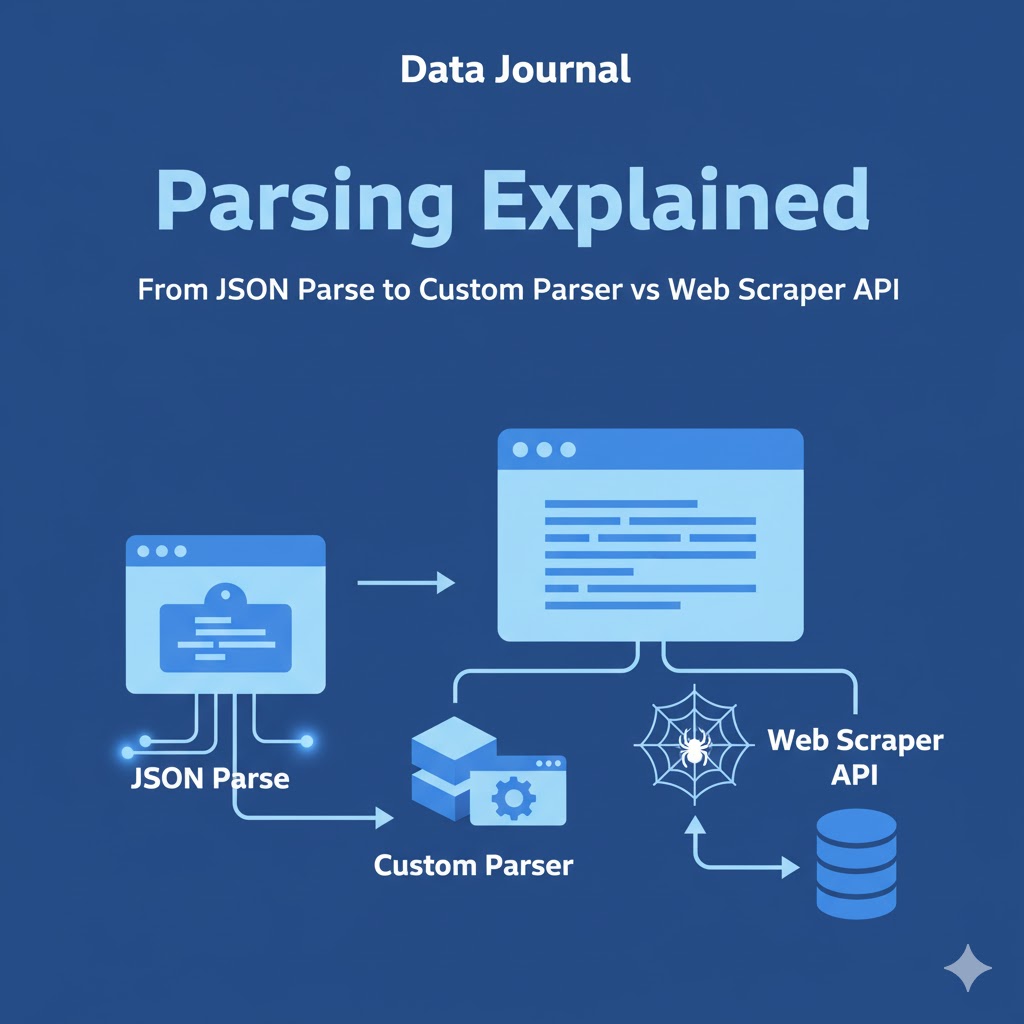
In the world of data, raw information is rarely in a format that is ready for analysis. This is where parsing comes in. Parsing is the fundamental process of converting unstructured or semi-structured data into a clean, organized, and usable format. For data engineers, developers, and growth teams, mastering the parsing of data is a critical skill for any project that involves data extraction and analysis.
This article provides a practical explanation of parsing. We will cover what it means, how it differs from web scraping, and the various types of parsers you can use, from a simple JSON parser to a fully custom parser. We will also discuss the role of a web scraper API and how to build a robust data pipeline.
What is parsing of data?
The parsing of data is the process of analyzing a string of text or a data file to transform it into a structured format. This process takes an input, like the HTML of a webpage or a messy log file, and breaks it down into meaningful components, such as a list of products with their names, prices, and availability. Effective data parsing is the bridge between raw content and actionable insights.
What does parsing mean in everyday workflows?
In everyday data workflows, parsing means turning something unstructured into something an application can understand. For example, a data team might parse customer reviews to extract sentiment, star ratings, and product mentions. Or, a developer might parse an API response to display information in a user interface. This parsing of data is a constant, necessary step.
How does parsing relate to compilers and data engineering?
The concept of parsing has its roots in computer science and compiler design, where it refers to analyzing source code to understand its grammatical structure. In data engineering, the principle is the same: a data parser applies a set of rules to an input to produce a predictable, structured output, just as a compiler does with code.
Test LycheeIP's reliable proxy network.
How is parsing different from web scraping?
Parsing is different from web scraping because it is a distinct step in the data collection process. Web scraping is the act of retrieving data from a website. Parsing is the act of taking that retrieved data and structuring it. You scrape first, then you parse.
Where does a web scraper API sit in the pipeline?
A web scraper API is a tool that handles the first part of the process: fetching the data. It manages the complexities of making requests, handling blocks, and rendering JavaScript. Once the web scraper API delivers the raw HTML or JSON content, your data parser then takes over to perform the parsing of data and extract the specific information you need.
Which outputs should the parsing of data produce for analytics?
The parsing of data should produce clean, consistent, and well-typed outputs that are ready for analysis. The ideal output is often a structured format like JSON, Parquet, or a relational database table. This ensures that the data can be easily queried, joined with other datasets, and visualized in business intelligence tools.
Which parser types should you consider?
You should choose a parser type based on the format of your input data and how stable that format is. There is no single best data parser; the right tool depends on the job.
| Parser Type | Best For | Strengths | Limitations |
| Regular Expressions (Regex) | Simple, consistent text patterns. | Very fast and lightweight. | Brittle; breaks easily with small layout changes. |
| DOM Parsers | HTML and XML documents. | Great for navigating structured documents using selectors. | Can be slow on very large files; dependent on valid structure. |
| JSON Parser | API responses and JSON files. | Native and highly optimized in most languages. | Only works on valid JSON; fails on malformed input. |
| CSV Parsers | Tabular data in text files. | Simple and efficient for flat data. | Does not handle nested data structures. |
When is a custom parser the right call?
A custom parser is the right choice when you are dealing with a unique, non-standard data format or when you need to enforce complex business rules and validations during the parsing process. While building a custom parser requires more effort, it gives you complete control over the transformation logic.
Test LycheeIP's reliable proxy network.
How do regex, DOM, XPath, and a JSON parser compare?
- Regex: Best for finding small, specific patterns in a larger text.
- DOM and XPath: The standard for navigating and extracting data from HTML and XML.
- JSON Parser: The only correct tool for handling JSON data. A native JSON parser is built to understand the syntax of JSON perfectly.
How do you perform a JSON parse safely?
You perform a JSON parse safely by always validating the input and handling potential errors gracefully. Never assume that an API response or a file will be perfectly formatted.
What are common JSON parse errors and fixes?
The most common errors a JSON parser will encounter are due to malformed JSON, such as trailing commas, unquoted keys, or truncated data. The fix is to wrap your parsing logic in a try-catch block to handle these errors without crashing your application. You can then log the invalid data for debugging.
Which validation and testing patterns prevent silent failures?
To prevent silent failures in your data parsing, you should validate the output of your parser against a predefined schema. This ensures that all the required fields are present and that they have the correct data types. Writing unit tests for your data parser with a variety of sample inputs is also a critical best practice.
Which should you choose: a web scraper API or a custom parser?
You should choose a web scraper API when the primary challenge is reliably fetching the data, and you should focus on a custom parser when the primary challenge is structuring that data. In many real-world projects, you will use both.
What are the cost, time, and reliability trade-offs?
- Web Scraper API: This has a direct monetary cost but saves you significant development and maintenance time. It is generally more reliable for data fetching, as the provider specializes in handling anti-bot systems.
- Custom Parser: Building a custom parser has an upfront time cost but can be cheaper in the long run. However, it requires ongoing maintenance, as it will break whenever the source website changes its layout.
How do rate limits and anti-bot systems change the decision?
The presence of strong anti-bot systems makes a web scraper API an almost essential component. Trying to manage IP rotation, CAPTCHAs, and browser fingerprinting on your own is a massive and ongoing engineering challenge. A good web scraper API handles all of this for you, delivering the raw data so you can focus on the parsing of data. This is where a professional proxy service like LycheeIP becomes a critical part of the infrastructure that powers a good web scraper API, providing the clean, reliable IPs needed to avoid blocks.
Test LycheeIP's reliable proxy network.
What does a robust parsing of data pipeline look like?
A robust parsing of data pipeline is a multi-stage, monitored, and automated workflow that transforms raw input into analysis-ready data.
What are the stages from crawl to store?
- Fetch: Retrieve the raw data using a web scraper API or a direct request.
- Parse: Use a data parser to extract the required information.
- Validate: Check the parsed data against a schema to ensure its quality and integrity.
- Enrich: Add any additional information, such as timestamps or source URLs.
- Store: Load the clean, structured data into a database, data lake, or data warehouse.
How do you monitor, alert, and validate a data parser in production?
You monitor a data parser by tracking key metrics like the success rate of the parsing job, the number of null values in each field, and any schema validation errors. Set up alerts to notify you immediately of any sudden changes or spikes in errors, as this is often the first sign that a source website has changed.
Which terms matter in parsing and how do they relate?
Understanding the terminology is key to discussing parsing effectively.
- Data Parsing / Parsing of Data: The overall process of structuring raw data.
- Data Parser: The tool or script that performs the parsing.
- Web Scraper API: A service that fetches the raw data for you.
- Custom Parser: A parser you build yourself for a specific task.
- JSON Parser: A specialized data parser for handling JSON formatted data.
When should you worry about compliance and ethics?
You should worry about compliance and ethics from the very beginning of any data collection project. Parsing is a powerful technique, and it must be used responsibly.
What are safe-use rules for parsed data?
Always respect the terms of service of the data source. Do not use parsed data for any illegal or malicious purpose. If the data is copyrighted, ensure you have the right to use it.
How do you minimize risk with logging and PII hygiene?
Never collect or store personally identifiable information (PII) unless you have a legitimate and legal reason to do so, along with explicit consent. Anonymize data whenever possible and maintain a clear data retention policy.
Why might formal parsing theory help in practice?
While you may not need to be an expert in compiler theory to perform basic data parsing, understanding the formal concepts can be very helpful when building a complex custom parser. Concepts like grammars and parse trees provide a solid theoretical foundation for building robust and maintainable parsers.
Test LycheeIP's reliable proxy network.
Frequently Asked Questions:
1. What is parsing in simple terms?
Parsing is the process of taking messy, unstructured data and turning it into a clean, organized format that a computer can easily understand and work with.
2. What is the difference between data parsing and web scraping?
Web scraping is the act of fetching raw data from a website. Data parsing is the next step, where you take that raw data and extract the specific pieces of information you need in a structured way.
3. What is a JSON parser used for?
A JSON parser is a tool specifically designed to read and interpret data that is in the JSON (JavaScript Object Notation) format. It is essential for working with web APIs, which commonly use JSON.
4. When should I build a custom parser?
You should build a custom parser when you are working with a unique or non-standard data format that cannot be handled by off-the-shelf libraries, or when you need to implement complex validation and business logic during the parsing process.
5. How does a web scraper API help with the parsing of data?
A web scraper API helps by handling the difficult task of reliably fetching the raw data from a website, even if it is protected by anti-bot measures. This allows you to focus on the parsing of data itself, rather than on the challenges of data collection.
6. Is parsing of data legal?
The act of parsing itself is legal. However, the legality of your project depends on the data you are parsing. You must ensure you have the right to access and use the data, and that you comply with all relevant laws and terms of service.