What is Data Parsing? From Raw HTML to Structured Data
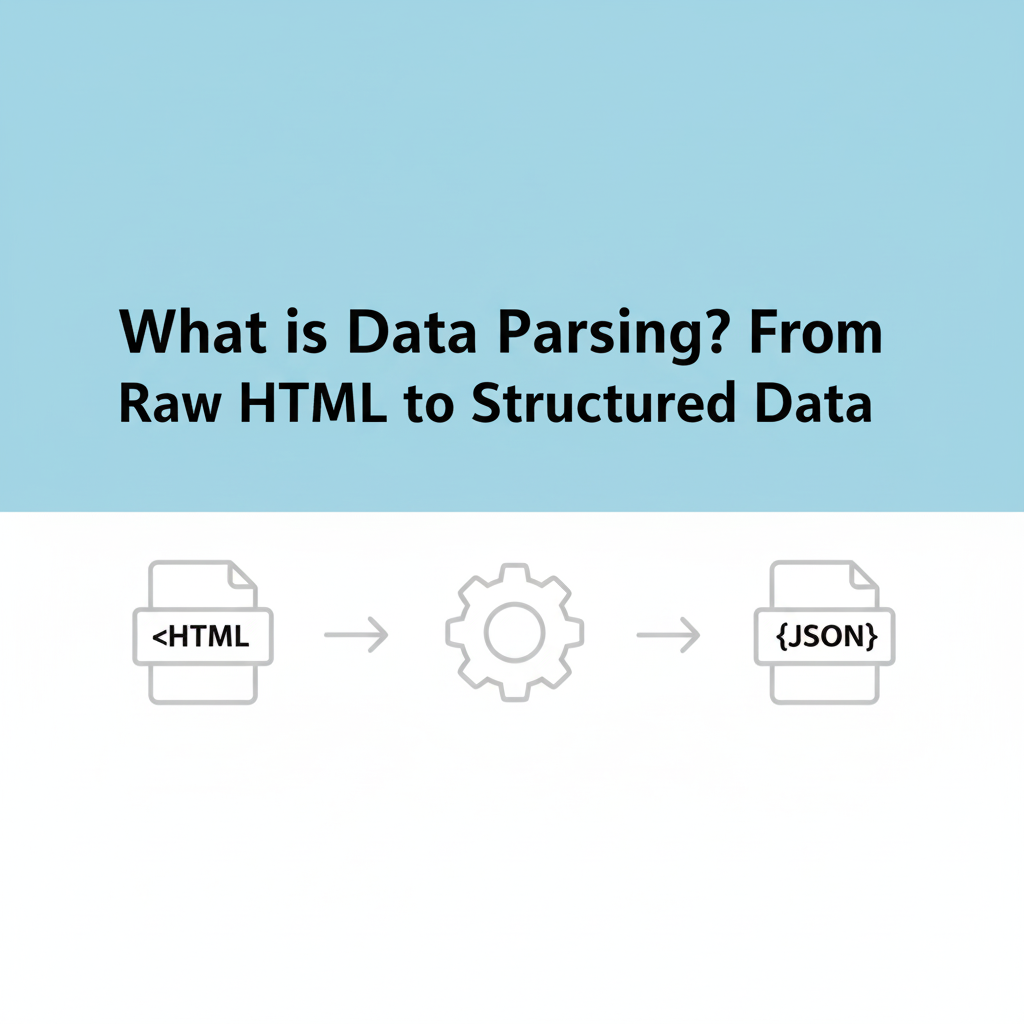
Data parsing is the crucial process of converting unstructured, raw data from the web into a clean, organized format that you can actually use. For any web scraping project, effective data parsing is the final step that delivers value. But before you can parse anything, you need reliable access to the source data.
This article explains the fundamentals of data parsing, from how an HTML parser works to formatting output as a CSV file. We’ll also cover the foundational role that a reliable unblocking proxy plays in ensuring your data parser has a consistent stream of information to work with.
Test LycheeIP's reliable and developer-friendly proxy network.
What Does Data Parsing Mean?
Data parsing means analyzing a string of text or a data file to break it down into a structured, meaningful format. The technical parsing meaning refers to analyzing syntax according to a formal grammar. In a practical data context, parsing is the act of taking a raw source like a web page's HTML, and transforming it into organized rows and columns for analysis or storage.
How Does an HTML Parser Work in Web Scraping?
An HTML parser works by reading the raw HTML markup of a web page and constructing an in-memory tree structure, often called the Document Object Model (DOM). This tree represents the page's hierarchy, allowing a web scraping script to navigate it and select specific elements like a product title or price using selectors. A good HTML parser is also designed to handle malformed or invalid HTML, which is common on the web.
Test LycheeIP's reliable and developer-friendly proxy network.
A simple web scraping workflow looks like this:
- Make an HTTP request to a URL to fetch the raw page content.
- Feed the HTML content to an HTML parser (like BeautifulSoup in Python).
- Use the parser to select specific elements by their tags or attributes.
- Extract and clean the text or data from those elements.
Which Data Parser is Right for Your Data Source?
The right data parser is the one specifically designed for the structure of your source data. You wouldn't use an HTML parser on a simple CSV file, and vice versa. Each format has a specialized tool that understands its unique syntax and rules.
| Data Source | Recommended Data Parser | Best For | Key Challenge |
| HTML Pages | An HTML parser (e.g., BeautifulSoup, Cheerio) | Extracting data from web page layouts. | Handling dynamic, JavaScript-rendered content. |
| JSON APIs | Native JSON library (e.g., Python's json) | Working with structured, predictable API data. | Schema changes breaking the parsing logic. |
| XML Feeds | XML parser (e.g., lxml) | Navigating complex, nested XML documents. | Dealing with namespaces and attributes. |
| CSV Files | CSV reader (e.g., Pandas read_csv) | Processing tabular, flat-file data. | Incorrect delimiters or quote escaping. |
Why is an Unblocking Proxy Essential for Data Parsing?
An unblocking proxy is essential because it ensures your data parser receives a consistent stream of raw data by preventing web scraping blocks. Your parsing code is useless if your scraper is hit with CAPTCHAs or IP bans. An unblocking proxy service like LycheeIP provides access to a vast pool of clean, high-reputation residential IPs.
By rotating requests through this network, your scraper's traffic appears organic and avoids detection. This provides the stable foundation necessary for any serious data parsing pipeline. An effective unblocking proxy strategy is the first step to successful parsing at scale.
Test LycheeIP's reliable and developer-friendly proxy network.
How Do You Correctly Format Data into a CSV File?
You correctly format data into CSV by using a library that handles proper quoting, escaping, and delimiters according to established standards like RFC 4180. Simply joining strings with commas is not enough and will lead to errors when a data field itself contains a comma or a newline character. A robust data parser workflow should output clean CSV files that can be universally understood.
For reliable CSV exports, always:
- Use a standard library to write rows.
- Enclose fields in quotes if they contain the delimiter or newlines.
- Use UTF-8 encoding unless you have a specific reason not to.
When Should You Validate Your Parsed Data?
You should validate your parsed data both during development and continuously in production. Websites change their layouts frequently and without warning, which can silently break your HTML parser's selectors and corrupt your data pipeline. Implementing automated checks is critical for maintaining data quality after the initial parsing is complete.
Implement checks that monitor for:
- An unexpected increase in null values.
- Changes in data format (e.g., a date string changing from "Oct 02, 2025" to "2025-10-02").
- Sudden, drastic shifts in numerical data points.
Test LycheeIP's reliable and developer-friendly proxy network.
Frequently Asked Questions:
1. What is the general meaning of parsing?
The general parsing meaning is the act of analyzing a sequence of symbols or text to understand its grammatical structure. In computing and data science, this means converting raw data into an organized format that a program can use and understand.
2. What is the difference between a data parser and an HTML parser?
An HTML parser is a specific type of data parser designed exclusively to read and interpret the structure of HTML documents. The term "data parser" is more general and can refer to a tool for parsing any type of data, including JSON, XML, or CSV.
3. What are common data parsing errors?
Common errors include failures due to incorrect character encoding, malformed structures (like mismatched quotes in a CSV), or changes in the source website's layout that cause an HTML parser's selectors to fail.
4. How does an unblocking proxy help with web scraping?
An unblocking proxy helps by routing a scraper's requests through a large pool of IP addresses. This prevents the scraper from being detected and blocked by websites, ensuring a steady flow of data for parsing.
5. What is the goal of data parsing in a project?
The primary goal of data parsing is to transform unstructured or semi-structured raw data into a clean, structured format (like a database table or CSV file) that is ready for analysis, reporting, or machine learning.
6. Do I need to build my own data parser?
No, you almost never need to build a data parser from scratch. Highly optimized and robust open-source libraries exist for nearly every data format, including tools for parsing HTML, JSON, XML, and CSV files.