Static vs Rotating Residential Proxies Explained
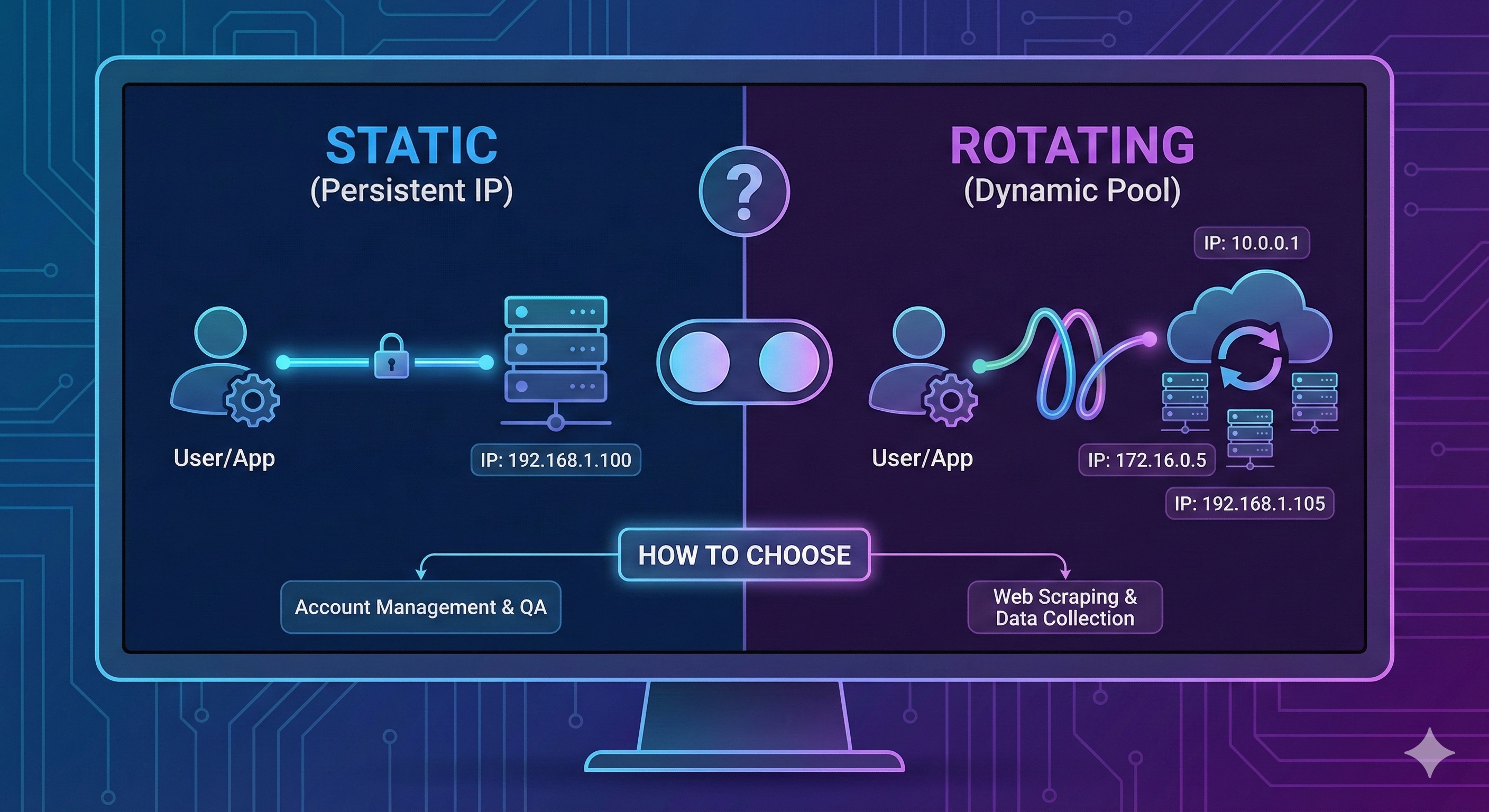
Wasting money on the wrong proxy type? Here's the difference.
Choosing between static and rotating residential proxies isn't just a technical networking decision—it's a fundamental financial one. Deploy the wrong proxy type for your automated data collection or QA project, and you will either burn through bandwidth costs unnecessarily or face constant connection resets, blocks, and CAPTCHAs.
The confusion in the industry stems from the fact that both proxy types serve legitimate, high-value purposes, but they are engineered for entirely different architectural use cases. Whether you are building an pipeline or running localized QA tests, understanding the underlying mechanics of your proxy is critical.
Understanding Static Residential Proxies
Static residential proxies assign you a fixed IP address sourced from a real, consumer-grade Internet Service Provider (ISP) that remains constant throughout your session—or even for weeks and months at a time.
Unlike datacenter proxies that use predictable IP subnets and scream "bot" to security systems, static residential IPs belong to actual home internet connections. Because they route traffic through legitimate ISP infrastructure and do not append the typical proxy-identifying information (like the detailed in MDN Web Docs), they are nearly indistinguishable from regular users.
Try LycheeIP Today
When Static Proxies Shine
Session-based activities—where maintaining a consistent identity is a strict requirement—are where static proxies dominate. Use cases include:
- QA and Geo-testing: Testing how localized content, ads, or checkout flows behave in specific regions without the IP shifting mid-test.
- Account Management: Managing authorized brand and social media accounts (Instagram, Facebook, TikTok) requires consistent IP addresses. Logging into the same account from rapidly changing IPs triggers security alerts and lockouts.
- E-commerce and Sneaker Testing: Authorized testing of limited-drop purchase flows and shopping carts, where a rotating IP mid-checkout will flag fraud detection systems.
- Banking and Financial Platforms: Any authorized, authenticated session that expects predictable user behavior patterns from a consistent geographic location.
Technical Advantages
Implementing provides developers with distinct architectural benefits:
- Strict Session Persistence: Cookies, login states, TCP connections, and stateful application flows remain valid and uninterrupted.
- Lower Block Rates for Stateful Apps: Target servers naturally trust IPs that exhibit established, consistent browsing histories.
- Predictable Behavior: Debugging network requests is vastly easier when your outbound IP identity remains a constant variable.
- Optimized for Rate Limits: Services that apply generous rate limits per IP (rather than strictly blocking scrapers) can be queried reliably with a dedicated address.
The Drawbacks
The primary drawback of static proxies is the cost structure. They cost significantly more per unit—often $2 to $5 per IP per month. If your application requires coverage across 50 distinct global cities, you are looking at $100 to $250 monthly just for the IP leases, regardless of bandwidth used.
Furthermore, they possess a single point of failure. If a platform flags your specific static IP due to aggressive querying, you are effectively stuck until you rotate it manually or request a replacement from your provider.
Rotating Residential Proxies: Built for Scale
Rotating proxies take a completely different approach: they automatically switch your IP address at set intervals or conditions—such as every request, every few minutes, or on-demand via an API endpoint.
Instead of leasing a single IP, your requests are routed through a massive pool of thousands or millions of residential IPs, distributing your traffic across vast, decentralized networks.
The Rotation Mechanisms
Understanding how to trigger rotation is key to optimizing your request success rate. Common mechanisms include:
- Per-request rotation: Every single HTTP/HTTPS request is routed through a different IP. This is the gold standard for stateless public data scraping.
- Time-based rotation: The proxy gateway assigns you an IP that automatically cycles every 5, 10, or 30 minutes.
- Session-based rotation (Sticky Sessions): The developer maintains the same IP using a specific session ID injected into the proxy authentication string. The IP is "locked" for a set duration, allowing for short bursts of stateful requests before returning to the pool.
Prime Use Cases
Rotating proxies are designed for stateless operations, distributed computing, and gathering public web data:
- Large-scale Public Data Collection: Extracting public information from thousands of pages concurrently without hitting server-side rate limits.
- SEO Monitoring: Checking search engine rankings across dozens of geographic locations simultaneously requires vast, diverse IP pools.
- Price Aggregation: Legitimate collection of public pricing data for market research and competitive analysis.
- Security Testing: Simulating distributed traffic to test your own infrastructure's resilience against automated threats.
Try LycheeIP Today
Why Scrapers Choose Rotating Proxies
To prevent server overload, modern web applications enforce rate limiting—often designed around frameworks like OWASP's guidelines on . Developers use to respectfully navigate these limits by:
- Distributing Request Loads: No single IP is forced to make aggressive or suspicious request volumes.
- Bypassing IP-based Restrictions: Rotation multiplies your concurrent capacity while keeping individual IP traffic footprints incredibly low.
- Achieving Geographic Diversity: You can seamlessly access localized public content as it appears in different countries, states, or even ASNs.
- Enabling Automatic Failover: If an IP drops offline or is blocked, the proxy gateway automatically retries the request with a fresh IP from the pool.
- Maximizing Cost Efficiency: You pay per gigabyte of bandwidth consumed, rather than paying for idle dedicated IPs.
The Trade-offs
The inherent nature of rotating proxies creates session discontinuity. Because the IP changes frequently, you cannot easily maintain logins, shopping carts break, and strict anti-bot systems may detect the rapid IP changes if your cookies do not match the IP location.
They are also billed by bandwidth (typically $3 to $15 per GB). This pricing model makes them incredibly expensive for video streaming, downloading large payloads, or rendering heavy JavaScript pages unless strictly necessary.
Cost-Benefit Analysis: Making the Right Choice
Determining the right infrastructure requires analyzing your exact technical requirements against the provider's pricing structures.
Pricing Models Compared
Static Residential Proxies:
- Pricing Structure: $2 to $5 per IP per month (typically includes unlimited bandwidth or very high caps).
- Best Value Profile: When you need a highly specific set of locations (e.g., 5 to 20 cities) for persistent tasks.
- Break-even Point: Cost-effective if you plan to push more than 50GB of traffic monthly through a single IP.
Rotating Residential Proxies:
- Pricing Structure: $3 to $15 per GB (grants access to the entire global IP pool).
- Best Value Profile: High-volume, stateless data collection across hundreds of different locations.
- Break-even Point: Becomes necessary when your operation requires 50+ different geolocations or executes upwards of 100,000 requests monthly.
Decision Framework for Developers
To streamline your architecture decisions, use this simple logic model:
Choose Static Proxies When:
- You are managing authenticated, logged-in sessions.
- Session persistence and strict cookie handling are required.
- You need fewer than 20 specific, permanent geographic locations.
- Your use case involves real-time interactions (live streaming, gaming, real-time QA).
- Your debugging workflow requires a consistent network identity.
Choose Rotating Proxies When:
- Stateless public data collection is your primary goal.
- You need geographic diversity at a massive scale.
- Your request volume far exceeds what a single IP can safely handle without triggering rate limits.
- You are executing parallelized GET requests without authentication.
- Your budget favors a pay-for-what-you-use (bandwidth) model over fixed asset costs.
The Hybrid Approach:
Many sophisticated engineering teams use both. Static proxies manage the initial account logins and authentication token generation, while rotating proxies are fed those tokens to handle the heavy, distributed data collection.
Try LycheeIP Today
Performance Considerations
- Speed and Latency: Static proxies almost always offer lower latency since you are utilizing a direct, dedicated connection. Rotating proxies introduce a slight overhead (usually 100-300ms) due to the proxy gateway managing IP switching, TCP handshakes, and pool routing.
- Success Rate Profiles: Static proxies yield higher success rates for complex, multi-step interactions (like filling out forms). Rotating proxies excel at firing simple, concurrent GET requests but can struggle if applied to stateful processes.
- Maintenance Overhead: Rotating proxies require significantly less manual infrastructure management. Developers don't need to write logic to replace "burned" IPs—the gateway handles failover automatically.
LycheeIP (Developer-First Proxy Infrastructure)
LycheeIP is a developer-first proxy and data infrastructure provider engineered to help technical teams route requests reliably at scale. When a team needs to scale their public data collection, conduct thorough QA across geographic regions, or build resilient network pipelines, they require infrastructure that handles the complexities of IP rotation, session management, and geographic targeting right out of the box. By providing a unified platform with seamless access to both static and dynamic IP pools, allows engineering and growth teams to focus on building their core applications rather than maintaining fragile in-house proxy servers.
The Verdict
The "wrong" proxy type isn't inherently worse—it is just mismatched to your specific network architecture.
Static residential proxies are surgical tools for precision work: maintaining sessions, managing specific accounts, and appearing as highly consistent users. Rotating residential proxies are industrial equipment for high-volume operations: scaling data collection, ensuring geographic diversity, and distributing request loads.
Calculate your actual technical requirements: concurrent requests per second, total number of target locations, session state requirements, and bandwidth payload sizes. The most expensive mistake isn't choosing the wrong proxy—it is failing to test both types against your specific workload in a staging environment before committing to a large-scale deployment.
Try LycheeIP Today
Frequently Asked Questions
Q: Can I switch between static and rotating proxies with the same provider?
A: Yes. Most enterprise proxy providers offer both static and rotating residential proxies under a single account. You can typically switch between them via API parameters or by routing traffic to different proxy ports, allowing you to seamlessly integrate both into a single microservice.
Q: How often do rotating proxies actually change IPs?
A: This depends entirely on your developer configuration. You can usually specify parameters for: per-request rotation (a new IP every HTTP request), time-based rotation (every 5-30 minutes), or sticky sessions (maintaining an IP by passing a specific session ID). For distributed scraping, per-request is standard.
Q: Are static residential proxies faster than rotating ones?
A: Generally, yes. Static proxies maintain dedicated connections with lower latency (typically 200-500ms response times). Rotating proxies introduce compute overhead from IP switching and network pool management, which can add latency per request. However, for parallelized operations, rotating proxies achieve vastly higher overall throughput by distributing the load.
Q: Can websites detect that I'm using residential proxies?
A: Advanced anti-bot systems can sometimes detect proxy usage through browser fingerprinting, TLS fingerprinting, or behavioral analysis—regardless of the proxy type used. However, residential proxies are significantly harder to detect than datacenter proxies because their IPs belong to real consumer ISPs. Proper header management and human-like request throttling further reduce this risk.
Q: What's the typical bandwidth cost difference between the two types?
A: Static proxies usually include unlimited (or very high) bandwidth caps at a flat rate of $2-5 per IP monthly, making them highly economical for consistent, moderate usage. Rotating proxies charge $3-15 per GB. This makes rotating proxies expensive for bandwidth-heavy tasks (like downloading media) but highly cost-effective for high-request, low-payload scenarios like querying JSON APIs or text content.