United Kingdom proxy: How to choose, Configure, and Test UK IPs
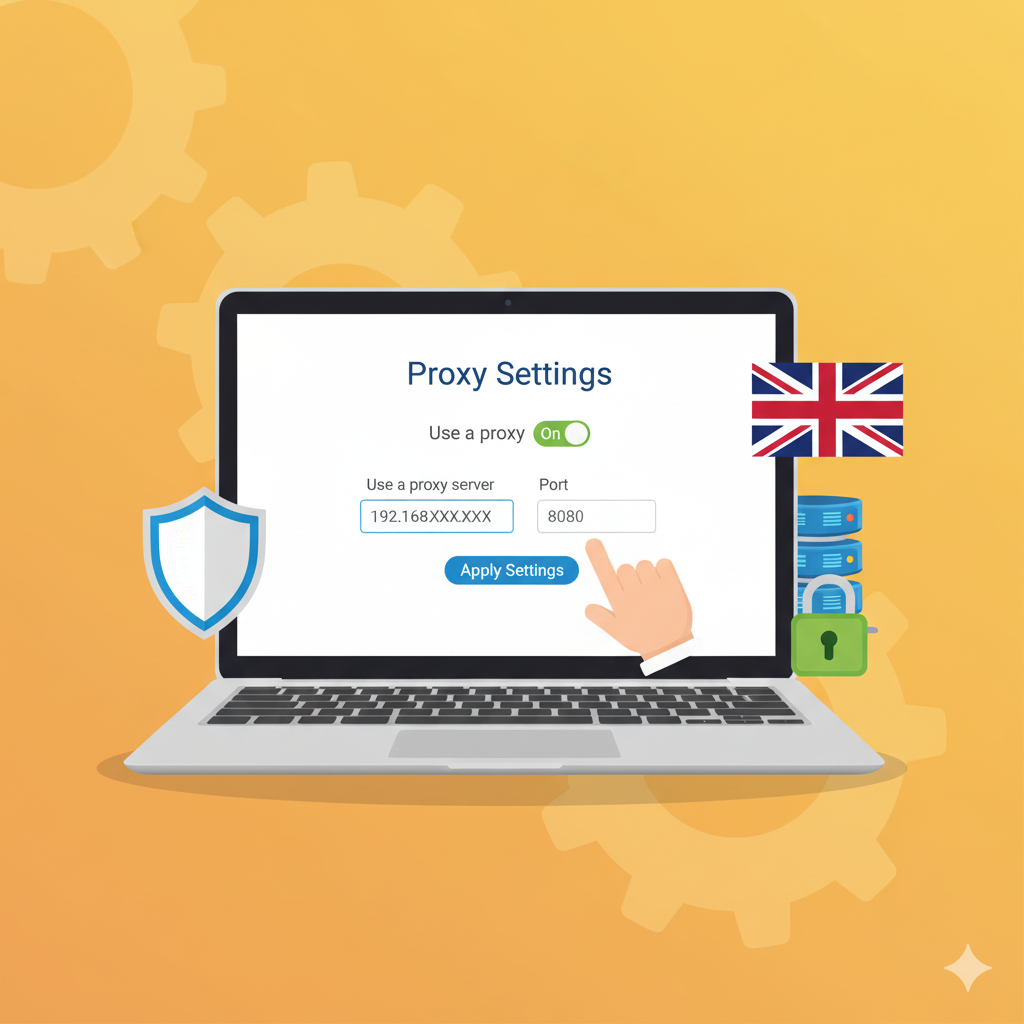
A United Kingdom proxy acts as an intermediary, routing your internet traffic through a server physically located in the UK. This process masks your original IP and makes it appear as if your connection originates from Great Britain (GB). Development, growth, and data teams use a British proxy for critical tasks like verifying geo-targeted ads, performing SEO analysis, or testing application localization.
This article explains how to select the right United Kingdom proxy server type, configure it for use, and reliably test its speed and performance. We will cover the differences between proxy protocols like HTTP and SOCKS, and why a reliable UK IP address is crucial for data collection.
Start testing with LycheeIP's clean proxies
What is a United Kingdom proxy and how does it work?
A United Kingdom proxy works by forwarding your connection requests to a target website through an intermediary proxy server based in the UK. The target website sees the request coming from the United Kingdom proxy IP, not your own. This server, which could be running open-source software like Squid or a proprietary system, intercepts your request, sends it to the destination (e.g., a united kingdom proxy site you want to access), receives the response, and then forwards it back to you. This is essential for any task requiring a local British proxy presence.
How do HTTP, HTTPS, and SOCKS5 differ for UK targets?
HTTP and HTTPS proxies operate at the application layer (Layer 7) and are designed specifically for web traffic. An HTTP proxy is the most common type for web scraping and browsing; many developers configure their own Squid proxy for this. SOCKS5, however, operates at a lower level (Layer 5) and is protocol-agnostic, as defined in IETF's RFC 1928. This means a SOCKS5 proxy can handle any type of traffic, including web, FTP, or custom TCP/UDP protocols, making it more versatile.
When choosing a United Kingdom proxy server, you'll select based on your application's needs. Most data collection tasks work perfectly with a high-speed HTTP or HTTPS proxy.
When is a web proxy enough for casual UK access?
A united kingdom web proxy (often a simple website where you paste a URL) is suitable only for quick, casual viewing of a single, static united kingdom proxy site. These services, often called a united kingdom web proxy, are unreliable, slow, and easily blocked. Many are found on a free proxy united kingdom list, which introduces significant security and speed risks.
For any serious development, testing, or data work, a united kingdom web proxy is insufficient. You cannot manage sessions, handle complex JavaScript, or ensure a stable UK IP address. A united kingdom web proxy is a poor choice for any professional task.
Which United Kingdom proxy type should you choose?
You should choose a United Kingdom proxy type based on your specific task's requirements for speed, cost, and block tolerance. The three main types are datacenter, residential, and ISP. Each originates from a different source and offers distinct advantages. Selecting the wrong one, like using a public proxy from a united kingdom proxy server list, can lead to high failure rates and bad data.
What are the tradeoffs between UK residential, ISP, and datacenter pools?
This is a critical decision for any team using a British proxy. UK residential proxies use IP addresses from real home internet connections, making them highly legitimate and difficult to block. They are ideal for sensitive targets. UK ISP proxies (or static residential proxies) are also issued by ISPs but are hosted on servers, offering high speed and a stable, non-rotating UK IP address for managing accounts. Datacenter proxies are the fastest and cheapest but are sourced from cloud providers, making them the easiest to detect.
Comparison of UK Proxy Types
| Proxy Type | IP Source | Best For | Key Tradeoff |
| UK Residential Proxies | Real user ISP (e.g., BT, Virgin) | Ad verification, scraping sensitive sites, social media | Highest legitimacy, highest cost, variable speed |
| UK ISP Proxies (Static) | ISP-owned (hosted in datacenters) | Account management, checkout testing, long sessions | High speed, stable UK IP address, high cost |
| UK Datacenter Proxies | Cloud/Hosting Providers | High-volume public data scraping, speed testing | Lowest cost, highest speed, easiest to block |
When do rotating UK proxies beat static sessions?
Rotating UK residential proxies are superior for large-scale data gathering, such as scraping e-commerce prices or monitoring SERPs across GB. Rotation, where your United Kingdom proxy IP changes on every request or after a set time, spreads your requests over a large pool, preventing any single UK IP address from being flagged. Static (or "sticky") sessions from UK ISP proxies are better for tasks that require a consistent identity, like managing a social media account or completing a multi-step checkout process from a single British proxy identity.
Do you need IPv4 or IPv6 for UK targets?
You almost certainly need IPv4 for a United Kingdom proxy because the vast majority of websites still operate on the IPv4 protocol. While IPv6 adoption is growing, many web properties, especially older or smaller UK-based sites, may not be accessible via IPv6. Relying solely on an IPv6 proxy will limit your access to any united kingdom proxy site that is IPv4-only.
How does IPv4 scarcity influence price and availability?
The RIPE NCC, the Regional Internet Registry for Europe (including the UK), ran out of new IPv4 addresses in 2019. This scarcity means that acquiring a clean United Kingdom proxy IP (IPv4) is more expensive. Providers must lease or acquire existing blocks, driving up the cost for premium UK ISP proxies and residential IPs. Be cautious of any free proxy united kingdom service offering unlimited IPv4; they are likely recycled, heavily abused, and slow.
Where does IPv6 help or hurt success rate?
IPv6 can be highly effective for accessing modern, large-scale targets that support it (like Google or Facebook). Because the address pool is massive, IPv6 proxies can offer high speed and lower costs. However, using an IPv6 proxy to access an IPv4-only united kingdom proxy site will fail. A balanced approach often involves using IPv4 as the default and IPv6 for specific, compatible targets.
Start testing with LycheeIP's clean proxies
How do you configure a United Kingdom proxy in Chrome or Firefox with SwitchyOmega?
You configure a United Kingdom proxy in your browser by installing the SwitchyOmega extension, creating a new proxy profile, and entering the host, port, and authentication details provided by your proxy service. This extension is popular among developers for quickly switching between different proxy configurations, such as a local Squid server and a commercial British proxy.
Here are the typical steps:
- Install the "Proxy SwitchyOmega" extension from the Chrome or Firefox web store.
- Open the extension's options and create a new profile (e.g., "UK Proxy").
- Select the proxy protocol (e.g., HTTP, HTTPS, or SOCKS5).
- Enter the United Kingdom proxy server address (e.g., uk.your-provider.com) and port (e.g., 8000).
- If using an authenticated proxy (not a free proxy united kingdom service), enter your username and password.
- Save the profile and select it from the extension's icon to route your traffic.
What are the correct HTTP and SOCKS settings?
For an HTTP or HTTPS proxy, you will enter the server address and the port. For SOCKS5, you will use the SOCKS protocol setting and the corresponding SOCKS port. Always use the HTTPS or SOCKS5 settings for encrypted connections. A common mistake is mismatching the protocol in SwitchyOmega with the port provided by your United Kingdom proxy server. A Squid server, for instance, typically uses port 3128 for HTTP.
How do you verify your UK IP address after setup?
You can verify your UK IP address by visiting a geo-location website like ipinfo.io after activating your proxy profile. The site should display a GB location and the IP address of your United Kingdom proxy, not your home IP. This confirms your British proxy connection is active and that you are successfully routing through the UK.
How do you test speed and success rate for a United Kingdom proxy?
You test the speed and success rate of a United Kingdom proxy by running automated scripts, such as curl commands or Python requests, to measure connection times and check for successful HTTP status codes (like 200 OK) against your target UK sites. Relying on a random united kingdom proxy server list will almost always result in poor speed and high failure rates. Professional teams must test their proxy infrastructure.
What curl checks should you run?
The curl utility is excellent for a quick command-line test. You can measure different stages of the connection to identify bottlenecks. This simple test reveals if the proxy itself is slow or if the target united kingdom proxy site is the problem.
Bash
# Test connection speed and response code from a UK proxy
curl -x "http://USER:PASS@uk-proxy-host:PORT" \
-o /dev/null \
-s -w "Connect: %{time_connect}s | TTFB: %{time_starttransfer}s | Total: %{time_total}s | Code: %{http_code}\n" \
https://www.bbc.co.uk
This command measures connection time (time_connect), time to first byte (TTFB), and total time. A good United Kingdom proxy server will have low, consistent timings.
Which Python requests checks help reveal bans and blocks?
A Python script using the requests library can help you test a proxy at a larger scale. You can loop through a list of target URLs or even a united kingdom proxy server list to check for non-200 status codes, which often indicate a block, a CAPTCHA, or a failed connection from your united kingdom proxy ip.
Python
import requests
# Configure your united kingdom proxy ip and credentials
proxies = {
"http": "http://USER:PASS@uk-proxy-host:PORT",
"https": "http://USER:PASS@uk-proxy-host:PORT",
}
target_url = "https://www.some-uk-ecommerce-site.com"
try:
response = requests.get(target_url, proxies=proxies, timeout=10)
print(f"Status: {response.status_code}")
if "captcha" in response.text.lower():
print("Block detected: CAPTCHA page served.")
except requests.exceptions.RequestException as e:
print(f"Request failed: {e}")
This script checks not only the status code but also the page content for keywords like "captcha," a common sign your proxy is flagged.
Start testing with LycheeIP's clean proxies
Why do UK proxies trigger CAPTCHAs and how can you reduce them?
UK proxies trigger CAPTCHAs because bot detection systems flag suspicious traffic patterns, high request volumes, or known IP reputations associated with your United Kingdom proxy IP. If you are using a datacenter proxy or an IP from a free proxy united kingdom list, it is likely shared by many users and has a poor reputation.
Which signals get flagged by bot defenses?
Bot defenses flag more than just the UK IP address. They check:
- High Request Rate: Making hundreds of requests per minute from a single British proxy IP.
- IP Type: Datacenter IPs are flagged more often than UK residential proxies.
- Header/TLS Fingerprinting: Mismatched or unusual browser headers that don't look like a real browser.
- Behavioral Gaps: Lacking mouse movements, cookies, or normal browsing patterns.
- A common free proxy united kingdom proxy will fail these checks instantly.
What rotation cadence and browser profile helps?
Using UK residential proxies with smart rotation is the most effective solution. For scraping search results, rotate your United Kingdom proxy IP on every request. For managing an account, use a "sticky" session from one of the UK ISP proxies for 10-30 minutes to maintain session continuity. Pairing this with realistic browser user-agents and headers significantly reduces block rates.
Is using a United Kingdom proxy legal and safe?
Using a United Kingdom proxy is legal for legitimate purposes, but using it to commit illegal acts or violate a website's terms of service is not. The proxy itself is just a tool. The legality depends on your actions.
Using a British proxy for data collection is a standard business practice, but safety is a concern. Avoid any united kingdom proxy server list from an unknown source, as these free proxy united kingdom services may inject malware or steal your data. A reputable provider ensures your connection is secure.
What does the Computer Misuse Act cover?
The UK's Computer Misuse Act 1990 is the primary legislation. It criminalizes unauthorized access to computer systems. This means using a proxy to guess passwords, breach a login, or access data you are not permitted to see is illegal. Always operate with consent and within the public-facing boundaries of a united kingdom proxy site.
Which use cases are typically allowed with consent?
Legitimate use cases are common for a United Kingdom proxy server. These include:
- Ad Verification: Checking that your paid ads are displaying correctly in different GB regions.
- SEO Monitoring: Scraping search engine results for your brand's keywords to check rankings from a UK IP address.
- Localization Testing: Ensuring your application's language and currency display correctly for UK users.
- Public Data Aggregation: Collecting publicly available information like product prices or business listings from a united kingdom proxy site.
Which providers and plans work best for UK use cases?
The best providers offer clean, stable United Kingdom proxy pools with clear pricing and strong developer support. LycheeIP, for example, focuses on providing simple, reliable proxy infrastructure for data teams. Instead of complex "unlocker" tools, we provide direct access to high-quality UK residential proxies and UK ISP proxies with predictable, pay-as-you-go pricing. This developer-first approach means you get a fast, stable United Kingdom proxy server without unnecessary overhead.
When to pick pay-as-you-go vs monthly plans?
Choose pay-as-you-go (PAYG) plans when your data collection needs are variable or you are just starting a project. This model, common for UK residential proxies, lets you pay only for the bandwidth you use. Monthly plans are better for predictable, high-volume workloads, such as continuous monitoring, where you can secure a set number of UK ISP proxies or datacenter IPs at a fixed cost.
What to check in a free trial or money-back guarantee?
A free trial should be used to actively test the proxy pool against your actual targets. Check for connection speed, success rates (aim for >98%), and the quality of the United Kingdom proxy IP pool. Make sure the trial gives you access to the premium pools (like UK residential proxies), not just a low-quality united kingdom proxy server list. A transparent trial lets you run the curl and Python tests mentioned earlier to validate performance.
Start testing with LycheeIP's clean proxies
Frequently Asked Questions:
- What is the best UK IP address for web scraping?
The best UK IP address for scraping sensitive targets comes from UK residential proxies. For high-volume, less sensitive public data, datacenter proxies offer better speed and cost. - Can I set up my own United Kingdom proxy server?
Yes, you can set up your own United Kingdom proxy server using software like Squid on a UK-based VPS. However, this gives you only one United Kingdom proxy IP, which is easily blocked. It's unsuitable for data collection at scale. - How do I find a reliable united kingdom proxy server list?
Finding a reliable free united kingdom proxy server list is extremely difficult. Most free lists contain slow, unreliable, or malicious proxies. Reputable providers offer access to large, clean, and private proxy pools, which is the standard for business use. - Are UK residential proxies faster than datacenter?
No. Datacenter proxies are almost always faster because they are hosted on high-bandwidth servers. UK residential proxies route through home internet connections, which have more variable speed, but they are chosen for their high-quality IP reputation, not raw speed. - What is a united kingdom web proxy used for?
A united kingdom web proxy is a simple website used for casually viewing a united kingdom proxy site from a GB perspective. They are not suitable for development, scraping, or secure browsing as they often break on modern websites and may be unsafe. - Why is my British proxy connection slow?
Your British proxy connection may be slow due to high latency to the server, low bandwidth on the proxy itself (common with free proxy united kingdom services), or rate-limiting by the target website.